Source record
Anxiety as the New Normal: When the World Accelerates Faster Than Our Minds
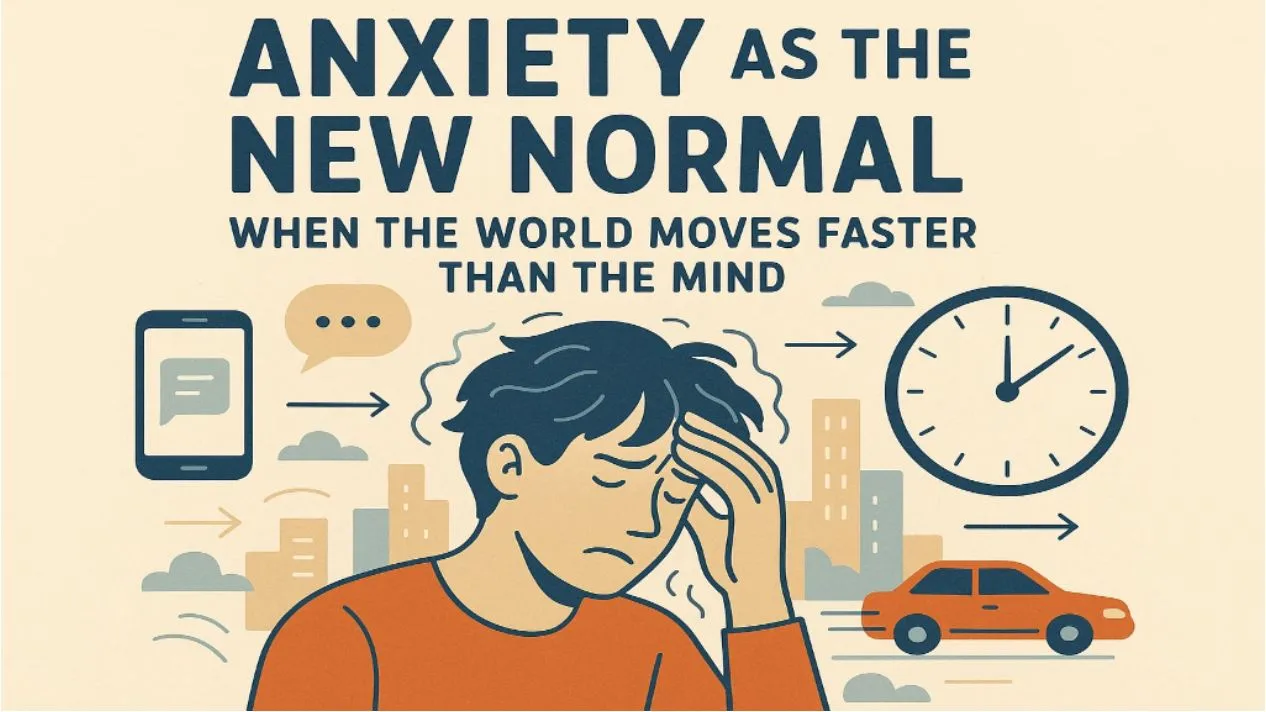
Imagine waking up already feeling behind. Before you even get out of bed, your phone’s screen floods you with overnight emails from work, news alerts about far-off crises, and a slew of social media updates. You haven’t brushed your teeth yet, but your heart is racing – and you can’t quite explain why. By the time you sit down with a cup of coffee, your mind is juggling today’s to-do list, worries about an unread message, and a vague sense that you’ll never catch up. Sound familiar? In a hyper-connected world where everything moves at breakneck speed, many of us live in a baseline state of anxiety. The provocative question is: are we truly ill with anxiety – or are we simply struggling to adapt to a world that’s changing faster than our psyches can keep up?
This bold statement captures a growing perspective: that much of our modern anxiety is not so much a pathological illness as it is an adaptive response to unprecedented change. In fact, some psychologists argue that “the madness we collectively feel isn’t an illusion — it’s the most natural response to an increasingly unnatural world”. In other words, if you feel on edge these days, it may be because human brains – evolved for a slower, simpler environment – are scrambling to adjust to the rapid-fire demands of modern life. Let’s explore how phenomena like technostress, information overload, and the “always on” lifestyle are making anxiety a new norm, and consider whether this anxiety might actually be part of our adaptation to a dramatically different reality.
Thanks to technology, we can work, socialize, and consume information 24/7 – and often we’re expected to. Being constantly connected has clear benefits (convenience, instant communication), but it also comes with a heavy psychological price. Mental health experts warn that being “always on” – perpetually available via devices – can cause stress, anxiety, depression, and other mental health challenges. When work emails ping at midnight and social networks beckon at dawn, our brains never get a genuine off-duty moment.
It’s not just intuition; research backs this up. A study in Germany found that employees who were expected to remain reachable after hours had measurably higher levels of the stress hormone cortisol, and they reported feeling significantly more stressed. In essence, the mere expectation of checking in (even if you’re not actively working) keeps your body in a state of heightened alert. This blurring of work-life boundaries – what one article called a culture that “increasingly blurs the lines between work and leisure” – makes it “very difficult for us to ever truly disengage from work and relax”. It’s a classic example of technostress, the strain we feel when trying to cope with technological demands.
Technostress can take many forms. Have you ever felt compelled to respond to a work message immediately, even late at night? Or felt anxious because you’re not checking your phone? These are symptoms of technostress. Psychologists define technostress as the mental strain caused by an inability to adapt to new technologies in a healthy way. We may develop a “compulsive need to stay connected”, feel we must multi-task constantly, or push ourselves to work faster just because our devices deliver information faster. The result is often overwhelm. Craig Brod, who pioneered research on technostress, famously called it “a modern disease of adaptation” – not a personal weakness, but a byproduct of our minds struggling to cope with ever-evolving tech. In a sense, our jobs and lives demand us to run “godlike software on Stone Age hardware” – we are using ancient brains, wired for a slower world, to meet the nonstop demands of the digital era.
One hallmark of the always-on culture is that nagging guilt or worry if we disconnect. Two-thirds of workers in some surveys say they feel powerless to fully switch off from work, leading to chronic stress and burnout. It’s no wonder some countries have started enacting “right to disconnect” laws (France, for example) to protect employees’ down time. Globally, people in all professions – from doctors and teachers to entrepreneurs and factory workers – report similar struggles with constant connectivity. Whether it’s a teacher answering parent messages at 10 PM or a software developer expected to monitor servers over the weekend, the pressure to be constantly available takes a toll. Have you ever caught yourself replying to a work email on a family holiday? If so, you’ve felt how being always on erodes the buffer between work and personal life, breeding anxiety.
Alongside constant connectivity comes another modern affliction: information overload. We live in an age of infobesity– a gluttony of news, notifications, and content competing for our attention every minute. Our phones and computers bombard us with more information in a day than previous generations might have encountered in weeks. The human mind, however, has finite bandwidth. When you try to drink from a firehose of information, something’s got to give.
Cognitive scientists describe a phenomenon called “attention residue”: every time you switch tasks or get interrupted by a notification, a part of your mind stays stuck on the previous task, reducing your focus on the next one. In practical terms, if your concentration is constantly shattered by pings and pop-ups, you end up mentally scattered and exhausted. Modern workers often juggle emails, chats, and reports all at once; students toggle between researching and constant social media; everyone is trying to parse an endless stream of news headlines. It’s no surprise that memory, attention span, and concentration suffer. We walk around with that foggy, frazzled feeling – like a web browser with too many tabs open. Over time, this mental overload generates a state of constant alertness (always waiting for the next bit of info) which increases stress and anxiety.
Consider how you feel after scrolling through a dense feed of news – from climate disasters to economic turmoil to the latest viral controversy – all within a few minutes. A term often used is “infomania,” the unhealthy obsession to continuously check and consume information. Our brains didn’t evolve to process global news 24/7. Yet now any moment of boredom invites us to refresh a feed for the latest updates, often leading to a mix of worry, sadness, or fear about events we can’t control. It creates a pervasive sense that something terrible is always happening somewhere, priming us to feel anxious by default. Is it any wonder so many people report feeling anxious for “no clear reason”, when in reality our minds are reacting to hundreds of micro-stressors from information overload each day?
The “always informed” society also breeds the Fear of Missing Out (FOMO). Knowing that we could know about every trend, every message, every piece of breaking news – and fearing that if we disconnect we’ll miss something important – is a new source of social anxiety. Ironically, the more connected we are, the more we fear being out of the loop. This keeps us glued to our devices in a self-perpetuating cycle: we check to relieve anxiety, but the checking itself often fuels more anxiety (perhaps we see upsetting news, or realize we truly did miss something). It becomes easy to feel like we can never fully relax, because the stream of information never stops.
Another layer making anxiety the norm today comes from how we relate to others online. Social media, for all its joys of connection, has a dark side: it creates constant opportunities for social comparison. We see curated highlights of other people’s lives – the promotions, the vacations, the happy selfies – and inevitably measure ourselves against them. As human beings, we’re wired to compare as a way to evaluate ourselves, but platforms like Instagram or LinkedIn crank this instinct up to toxic levels. Psychologists have found that heavy social media use is linked to higher rates of envy, low self-esteem, and feelings of inferiority. When you constantly feel “not enough” compared to what you perceive others are achieving, anxiety and depression aren’t far behind.
Moreover, many people feel pressure to present their best selves online. Maintaining an image, gathering likes, or simply the awareness of being constantly seen/judged by an online audience can be anxiety-provoking. There’s even a term “social media anxiety disorder” for those who feel compelled to behave in certain ways to gain approval online. It’s a vicious cycle: we compare ourselves to others’ perfect images, feel inadequate, then anxiously try to perfect our own image. In the end, we may all end up more insecure. As the saying goes, we’re comparing our behind-the-scenes with everyone else’s highlight reel – a recipe for angst.
Why do these modern circumstances trigger so much anxiety? The answer lies partly in our neurophysiology – how our brains and bodies handle stress. Human biology evolved to deal with immediate, short-term threats (like, say, being chased by a wild animal). When faced with danger, our amygdala (the brain’s fear center) sounds the alarm, and our body releases stress hormones like adrenaline and cortisol. This “fight or flight” response helped our ancestors survive occasional life-or-death emergencies. The problem is, today’s threats are often abstract, chronic, and technologically mediated: an angry email from your boss, a news report of a distant war, the constant drip of obligations and uncertainties. Yet our bodies react in the old ways. That email that arrives with a loud ding may spike your adrenaline; doomscrolling bad news before bed keeps your cortisol elevated and your mind on edge. Our ancient nervous system is being triggered far more frequently than it was meant to, and too much exposure to stress hormones can wreak havoc on our well-being.
One striking study measured people’s cortisol levels over days when they were and weren’t required to be available for work. It found that on the “always available” days, people’s cortisol was significantly higher – essentially, their bodies were in a constant mini stress-response mode. Even when they were at home trying to relax, the anticipation of a possible work call or email kept their physiology on high alert. Continuous partial stress like this can lead to symptoms such as insomnia, irritability, and fatigue. Over time, it contributes to chronic anxiety: the brain gets used to being in a vigilant state and has trouble winding down.
Neuroscientists have started noticing actual changes in brain structure and function from heavy technology use. Excessive multitasking and screen immersion have been linked to reductions in gray matter density in areas like the anterior cingulate cortex (which is involved in emotion regulation and decision-making). While research is ongoing, early findings suggest our digital habits might be physically rewiring our brains, potentially making us more prone to distraction and anxiety. In evolutionary terms, we are experiencing a massive “mismatch”: our brains evolved over millennia for a world of face-to-face interaction, ample rest, and modest stimuli. Suddenly – in the past decade or two – we’re faced with exponential technological acceleration. As one commentator put it, “our ancient brains, which evolved for linear, predictable change, now face exponential technological acceleration… creating unprecedented strain”. We’ve created a world we didn’t evolve to inhabit , and our psyches are scrambling to catch up. Little wonder that modern life fuels heightened anxiety, loneliness, and unhappiness – we’re essentially fish out of water, biologically speaking.
On a broad scale, this manifests as what some have dubbed a “psychological climate change”. Just as environmental climate change stresses ecosystems beyond their capacity, our fast-paced digital environment is stressing our mental ecosystem beyond what it was designed for. Anxiety, then, could be seen as a canary in the coal mine– a natural warning signal that things have changed too much, too fast. Perhaps feeling anxious is, in a twisted way, a sign that you are human and your natural systems are reacting as they should to an unnatural barrage of pressures.
It’s important to note that clinical anxiety disorders are very real and often require professional help. But even people without a diagnosed disorder report higher anxiety levels now. In fact, worldwide about 1 in 8 people live with a mental disorder, and anxiety and depression rates spiked by over 25% during the tumultuous year of 2020. Our “new normal” seems to include a baseline anxiety that would have been unusual in calmer times. So if you find yourself frequently tense or worried, it might not be just you – it might be a reflection of genuinely anxiety-provoking global conditions and a brain that is trying, against the odds, to adapt.
A man sits awake late at night, the glow of his smartphone the only light in the room as he bows his head in exhaustion. Scenes like this have become common – individuals unable to disconnect even in the dead of night. His body is still, but his mind is racing with the day’s emails, tomorrow’s tasks, and the endless scroll of information. This image captures the plight of many in the modern world: physically exhausted but mentally hyperactive, caught in an “always on” cycle that blurs day and night. The result is often sleeplessness and a pervasive anxiety that carries into the next day.
One particularly damaging effect of this always-on cycle is on our sleep. The human brain and body restore themselves during sleep, but technology finds a way to intrude here too. Many of us bring our phones to bed, whether to check one last message or to lull ourselves to sleep with videos – only to find that we’re staring at the ceiling an hour later, wide awake. The blue light emitted by screens is known to suppress melatonin production, the hormone that signals our body it’s time to sleep. With our circadian rhythms disrupted, we may struggle to fall asleep or to get deep, refreshing rest. And as multiple studies have confirmed, poor sleep directly contributes to higher anxiety levels and lower emotional resilience. It’s a vicious cycle: anxiety can cause insomnia, and insomnia in turn makes us more susceptible to stress and anxiety. The always-on, information-saturated lifestyle effectively steals the tranquility of night, replacing it with a restless vigil. In the long run, chronic sleep deprivation further depletes our ability to cope, making the world seem even more overwhelming than it already is.
Faced with this whirlwind of tech-driven anxiety, what can we do? If the world isn’t slowing down, we have to get smarter about how we live in it. Part of adapting is individually learning to set boundaries and cultivate habits that protect our mental well-being. Part of it is also a collective conversation: how can workplaces, communities, and societies adjust so that humans can thrive, not just survive, in the digital age?
On the personal level, psychologists and wellness experts suggest a number of practical strategies to manage anxiety in an “always on” world:
Set boundaries with technology: Deliberately carve out tech-free time in your day. For example, you might declare no emails or social media after 8 PM, or keep meal times phone-free. Having specific hours for connectivity and a cut-off time to unplug can help you reclaim a sense of control and calm. By limiting work communications to defined periods, you signal to your brain that it’s okay to relax outside those times. Such boundaries can “help in minimizing anxiety and avoid being overwhelmed with an excess of information”. Engage in regular digital detoxes: You don’t have to abandon technology entirely, but taking breaks is healthy. Maybe one day a week (say, a Sunday) you mostly stay offline, or you decide to spend an afternoon hiking without your phone. These breaks act like a reset button for your overstimulated mind. Research shows even short periods away from screens can reduce stress. Unplugging allows your nervous system to downshift out of fight-or-flight mode. Limit notifications and interruptions: Those little pings and buzzes are deceptively powerful at hijacking attention. Customize your devices to cut down on non-essential notifications – do you really need news alerts for every trending article, or could you check news intentionally once a day? Consider using “Do Not Disturb” or focus modes during work or before bedtime. By regaining control over when and how you receive information, you prevent constant jolts of anxiety. Silencing the stream of interruptions helps you focus on one thing at a time, lowering background stress . Prioritize real-life connection and activities: Make time for offline activities that ground you in the here and now – whether it’s having coffee with a friend, playing a sport, doing some gardening, or reading a book (on paper!). Human brains find comfort in face-to-face socializing and in tactile, physical experiences. When you engage with the real world, the virtual worries often shrink in perspective. Strong personal relationships, in particular, are a proven buffer against stress. In an always-online era, scheduling a walk with a friend or a family game night can be a radical act of self-care. Practice mindfulness and stress management techniques: Techniques like mindfulness meditation, deep breathing exercises, or yoga can help retrain your anxious brain. These practices encourage you to slow down, observe your thoughts without judgment, and return your focus to the present moment. Over time, mindfulness can reduce the rumination and hyper-vigilance that fuel anxiety. It’s essentially exercise for your mental resilience – helping you cultivate an inner calm even when the external world is chaotic. Many have found that mindfulness and breathing exercises “build your resilience as well as reduce the anxiety that comes with the use of technology”.
On a broader level, adapting to this new reality might require cultural shifts. Workplaces can foster healthier expectations by respecting employees’ personal time (for instance, not expecting instant replies at night). Schools can incorporate digital literacy that includes mental health – teaching young people how to navigate social media without losing self-esteem. Tech companies themselves could design with wellness in mind, introducing features that encourage breaks or more meaningful engagement rather than endless scrolls. Some changes are happening: the latest smartphones have “screen time” trackers and wellness modes, and there’s public conversation about the ethics of the attention economy. But ultimately, each of us faces the challenge of creating balance in our own life.
As we implement coping strategies, it’s worth asking some deeper questions too. If anxiety is the new normal, what does that say about the world we’ve created? In framing everything as an individual problem (“manage your anxiety better”), we risk ignoring the systemic causes of our distress. Perhaps we should also be asking: How might we redesign aspects of society to be more in tune with human needs? History shows that societies have navigated disruptive changes before – from the Industrial Revolution’s upheavals to the introduction of electricity – eventually finding new equilibriums. Are we now at such a juncture with the digital revolution? Is our collective anxiety a sign that we need to course-correct the pace or manner in which technology pervades our lives?
Are you anxious – or simply adapting to a new reality? This question is meant to provoke reflection. It could be that the answer is “both.” Feeling anxious might be a natural part of the adaptation process; growing pains on a societal scale. Acknowledging this can be empowering: it shifts the narrative from “I have an anxiety problem” to “We are undergoing a difficult adaptation.” It doesn’t make the anxiety vanish, but it reminds us that we’re not alone, and that anxiety is not a personal failure. It’s a signal, telling us something important about the world we live in and the adjustments we need to make.
In the end, the goal isn’t to reject technology or long for some pre-digital past – it’s to adapt with awareness. We can embrace the wonders of our fast world while also fiercely guarding our mental well-being. Feeling uneasy in times of great change is nothing to be ashamed of; it might be a sign that you’re human and alert. Use that awareness as a catalyst: to set boundaries, seek balance, and perhaps to demand a world that values mental health as much as innovation. Anxiety may well be the new norm, but with understanding and intentional action, we can ensure it leads to growth and resilience rather than despair. After all, evolution isn’t comfortable – but it is how we progress.
So ask yourself again, next time your heart races at a late-night notification: Am I just anxious, or am I adapting? The very fact that you can pose that question means you’re already taking a step toward the latter. By recognizing anxiety for what it often is – a response to a hyper-speed world – you can start to regain agency. In this rapidly accelerating world, our challenge and opportunity is the same: to evolve our habits and minds to match our technologies, and in doing so, transform anxiety from merely a sign of the times into a force that pushes us to find a new and healthier normal.