Source record
Burning Truth: Information Warfare in a Fahrenheit 451 World
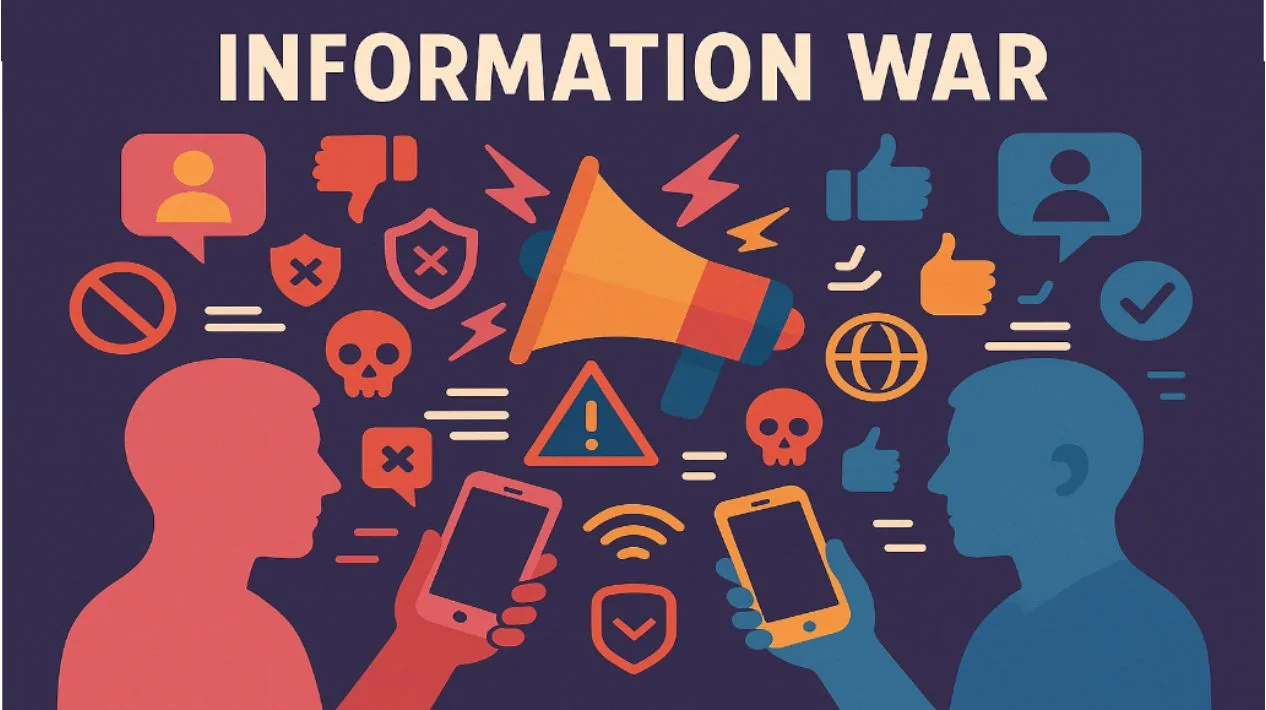
In Ray Bradbury’s “Fahrenheit 451”, firemen don’t douse flames – they ignite them, burning books to ash in a war against knowledge. In that dystopia, reality is erased one page at a time, replaced by state-approved illusion. Today, we face a similar bonfire of truth, but the flames are digital and the arsonists often unseen. No physical books burn, yet facts and memories are being incinerated in the blinding blaze of disinformation that engulfs our screens. The result is a world where the line between fact and fiction blurs, and reality itself feels under assault.
From Beijing to Brasília, Boston to Bengaluru, a new kind of warfare rages – an information war that respects no borders. In China, the government tightly controls the narrative, flooding media with patriotic messaging while scrubbing out inconvenient truths. Alternate realities are constructed where controversies vanish and the party line prevails. In India, viral WhatsApp rumors have ignited real-world violence, as false stories of child kidnappers or religious threats spread like wildfire through villages, eroding trust and prompting mob attacks. In Brazil, waves of fake news preceded recent elections, so much so that authorities tried to ban “false or seriously decontextualized” content. Even then, conspiracies about “stolen votes” spread widely online – and in early 2023, throngs of citizens, misled by those digital lies, stormed government buildings in Brasília in a tragic echo of America’s Capitol riot. And in the United States, the land of free expression, disinformation has flourished in the open: conspiracy theories like QAnon moved from fringe message boards into mainstream politics, and blatant falsehoods about election results or public health have splintered communities. Across the world, whether the source is an authoritarian regime or an internet troll in a democracy, the strategy is strikingly similar – distort reality, erode critical thinking, and exploit divisions.
This is not a series of isolated incidents; it’s a coordinated onslaught on the very idea of objective truth. The goal? Reshape public perception to serve an agenda – political power, social control, financial gain, or sheer chaos for its own sake. And thanks to modern technology, lies now travel at lightspeed, cloaked in the guise of credible information. It’s as if Fahrenheit 451’s conceptual “firemen” are loose in our digital libraries, but instead of burning physical books, they algorithmically bury facts under an avalanche of falsehoods.
How has misinformation become so pervasive and potent? The arsenal of this new information war is filled with sophisticated tools and tactics. Key weapons include:
Deepfakes – AI-generated videos or audio that can make anyone appear to say or do anything. With enough polish, a deepfake video of a world leader declaring a fake emergency or a fabricated audio clip of someone “admitting” to a scandal can spread panic and confusion before truth has a chance to catch up. This technology puts an ominous question mark over every photo, voice, and video: “Is this even real?”
AI-Generated Content – Beyond deepfake video, artificial intelligence can churn out convincing fake news articles, social media posts, and images at scale. Propagandists no longer need an army of writers to flood the internet with false narratives – a single operator with AI can generate a tsunami of misleading content overnight. In one striking example, a phony image of an explosion at the Pentagon went viral in 2023, likely created by AI, and it even caused a brief stock market dip before being debunked. Such incidents show how a well-placed lie, enhanced by AI and amplified by sharing, can jolt the real world.
Wikipedia Manipulation – Even our crowdsourced well of knowledge is not immune. Wikipedia, often one of the first sources people check for information, has been a target of coordinated editing campaigns. In some cases, state-sponsored or ideologically motivated editors work subtly and patiently to skew articles – revising history, inserting biased viewpoints, or sanitizing facts – hoping that the changes slip past notice. There have been incidents where groups took over whole topic areas (even an entire language edition of Wikipedia) to push a certain narrative. The very platform built on collective truth-seeking can be twisted if enough gatekeepers are subverted.
Algorithmic Filter Bubbles – This is the invisible hand arranging what you see online. Social media feeds and search engines use algorithms that learn your preferences and feed you more of the same. Over time, users become sealed in echo chambers of their own beliefs. If you tend toward one political view, your feeds show you posts reinforcing it; if you’ve shown interest in conspiracy theories, you’ll see more of them. These filter bubbles mean that falsehoods can flourish unchecked among those predisposed to believe them. Within a bubble, a lie repeated a thousand times becomes truth – because alternative viewpoints never penetrate. It’s comfort food for the mind, served by an algorithm, and it can quietly poison our capacity for critical thinking.
These tools and tactics form the scorching weaponry of modern propaganda. They make deception easier, faster, and more believable than ever. A fake persona with a doctored profile picture can tweet endless divisive lies. An army of bots can swarm a Facebook post to make a fringe theory seem overwhelmingly popular. YouTube’s recommendation engine might nudge a curious viewer from a harmless video into extremist content through small algorithmic steps. In this high-tech information war, the traditional defenses – journalistic gatekeepers, expert analysis, healthy skepticism – are often bypassed or overwhelmed.
If these are the weapons, then social media platforms are the battleground. Meta, Twitter(X), YouTube, TikTok, and other platforms have become the primary theaters where the fight for truth plays out. It’s on these feeds and timelines that false narratives are launched and either take hold or are shot down. The design of these networks often gives an edge to falsehood. Why? Because outrageous, emotionally-charged content grabs attention – and attention is the currency of the social media economy. A misleading post that provokes anger or fear is likely to get shares and clicks, spiking engagement metrics that platforms reward. The algorithms don’t have moral judgment; they simply amplify whatever keeps people glued to the screen. Unfortunately, lies and conspiracies often prove more enticing than nuanced truths. A dramatic false rumor (“This miracle pill cures COVID overnight!”) spreads far faster than a boring fact-check (“Actually, no, it doesn’t”). Studies have shown that false news can spread farther and faster online than true news, purely because of this viral dynamics of emotion and novelty.
On these digital battlefields, social media companies play a complicated role. They are the new publishers and broadcasters, but for years many denied that role, insisting they were neutral platforms. In attempts to police misinformation, they’ve built fact-checking partnerships and content moderation teams, but those efforts are often reactive and inconsistent. Dangerous false content sometimes circulates for hours or days – long enough to inflict damage – before moderators take it down, if they do at all. And when bad actors can simply create new accounts or use coded language to evade detection, the whack-a-mole game never ends. Meanwhile, political forces accuse platforms of bias whether they act or don’t act, further muddying the waters. The result is that the public square is largely privately owned, driven by profit algorithms, and under constant siege by propagandists. We now see how a trending hashtag can influence an election’s narrative, or how a flood of comments (genuine or bot-driven) can manufacture a false “consensus” on an issue. This is information warfare in real time, before our eyes, every day on our phones and laptops.
Who drives this war? On one side are the opportunists – political demagogues, foreign intelligence operatives, extremist groups, even opportunistic marketers – anyone who benefits from manipulating public opinion. These actors exploit the new tools to spread propaganda or chaos. A politician may knowingly spread a blatant lie if it riles up their base and discredits opponents; if caught, they shrug and claim “fake news” to dismiss any contrary evidence. Authoritarians manufacture fake narratives to justify crackdowns, painting dissenters as threats with the help of fabricated "evidence." Foreign agents seed confusion among their rivals’ populace, hoping to weaken societies from within. Even corporations or special-interest groups join in, funding astroturf campaigns (fake grassroots movements) and sponsored misinformation to sway policy and perception in their favor. Never have the unscrupulous had such an easy megaphone. In the past, to mislead millions, they needed control of TV stations or printing presses. Now a half-legible meme on a fringe forum can snowball into a prime-time controversy if it catches the algorithm’s eye. For the opportunists, truth is malleable and expendable – a resource to twist or toss aside in pursuit of power or profit.
On the other side of this conflict, we find the unwary masses – essentially, all of us at times. The harsh truth is that disinformation only works if someone believes and spreads it. In Bradbury’s novel, citizens passively watch giant TV screens and stop asking questions; today, many of us similarly drift along endless social media feeds, only half-engaged. This passive digital consumption is a big part of the problem. When we mindlessly scroll through Facebook or Twitter late at night, we become easy targets. Outrageous headline? Share it in a flash, no verification, because it fits our feelings. Complex issue? Skip the nuance, accept the first catchy explanation that comes along. The psychology of misinformation preys on our biases and emotions – we are inclined to believe things that confirm what we want to be true. So, critical thinking withers. We start living in separate realities curated by our media diets. Neighbors, friends, even family members may no longer agree on basic facts, each convinced the other side is living in a fake world. This social fracturing is exactly what the peddlers of disinformation exploit. A divided, confused public is easier to manipulate.
Every time we fail to question a dubious claim, or forward a sensational rumor without checking, we become unwitting foot soldiers in the information war, advancing the enemy’s line. It’s a stark thought: the victors of this war won’t be decided by armies or weapons, but by awareness versus ignorance. And right now, the opportunists count on ignorance. They count on us remaining passive, divided, and cynical – too overwhelmed to verify anything, too jaded to trust anything, and thus susceptible to everything.
The situation may seem dire, but dystopia is not destiny. Bradbury’s warning in Fahrenheit 451 was meant to jolt us awake, and it’s exactly awakening that we need now. The antidote to a world where reality burns is to rebuild our collective commitment to truth. That starts with each of us. Media literacy must become as fundamental as reading and writing. We need to question what we see online, double-check sources, and learn to recognize common tactics of manipulation. Instead of scrolling passively, we can engage actively: if a story triggers a strong emotion – anger, fear, glee at an opponent’s misfortune – that’s a sign to pause and verify before reacting or sharing. Simply asking “Who might want me to believe this, and why?” can pop the bubble of a false narrative.
Education is key. Schools and communities should emphasize critical thinking and digital literacy from a young age, preparing citizens for a world in which not all information is created equal. But it’s not only up to individuals. Civic vigilance means holding our institutions and leaders accountable too. We must demand transparency from social media platforms about how their algorithms work and push them to dampen virulent falsehoods as rigorously as they boost engagement. We should support quality journalism and fact-checkers – the firefighters in this blaze – so that truth has champions and can’t be so easily drowned out. And we must insist that our leaders, regardless of party or ideology, renounce the easy path of disinformation. When public figures lie or spread conspiracy theories, a vigilant citizenry calls them out and refuses to accept “alternative facts” as a basis for policy or debate.
Finally, we should remember that the power of truth still burns brighter than any lie when we nurture it. Think of the handful of rebels in Fahrenheit 451 who each memorized a book to preserve knowledge – they chose light over darkness. Similarly, we each carry a bit of responsibility to preserve reality. It could be as simple as calmly correcting a friend who shares a false rumor, or as grand as building new tools to detect deepfakes. In this war, every action counts.
The battle against disinformation is ultimately a battle for the kind of world we want to live in. Do we want a world where reality is constantly in flux, set by those with the loudest megaphone or the shiniest fake video? Or do we want a world where, despite our differences, we can agree on fundamental truths and build trust in one another? Winning this fight won’t be easy – it requires effort, courage, and unity. But the stakes could not be higher: our shared sense of reality and reason.
The fire of falsehood is blazing, but it’s not unstoppable. Each of us can help douse it by staying informed and alert. So let’s open our eyes wide. Let’s sharpen our minds and refuse to be complacent. The next time you encounter a piece of news online, approach it with a healthy dose of curiosity and doubt – your modern-day fireproof armor. In a world where digital sparks can burn down the truth, we must all become firefighters of facts and guardians of reality. The future of our reality depends on the vigilance of ordinary people. It depends on us.