Source record
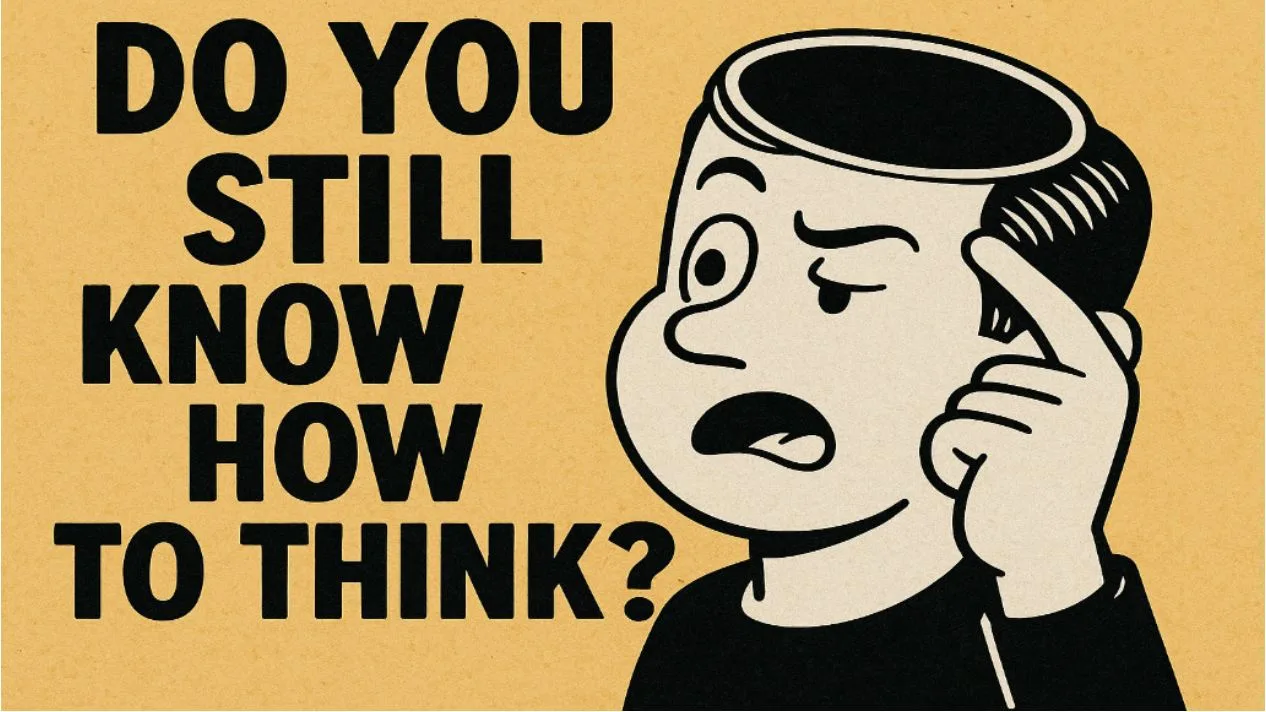
Do You Still Know How to Think?

Bad news: you are becoming dumber.
Good news: your brain can be rewired.
But here's the real question — do you even need to?
Every time you fire off a query to Google, give a voice command to Siri, or accept an AI suggestion, your brain gives itself a break. Instead of straining, the circuits power down. They get lazy. It is like going into autopilot mode — but on your own mind. Why think when a machine can fetch the answer in milliseconds?
You are the sum of your skills, habits, and knowledge. But what if those skills are being washed away? Vanished without a trace. Gradually. Permanently.
You aren’t exactly losing them — you’re simply not using them. And in the quiet hours, your memory begins to flicker. Eventually you forget you ever had those talents to begin with. Can you recall how to do long division mentally, or find your way in an unfamiliar city without a phone? Chances are, you’d pause and realize maybe you don’t remember anymore.
For example, when was the last time you navigated a new route without GPS or calculated a tip without pulling out your phone? If you struggled or hesitated, that’s no surprise. Our minds literally forget what they rarely use.
Neuroplasticity is just a scientific term for your brain’s ability to rewire itself. In simple terms: your brain is like a muscle. Use it and it grows stronger; let it idle and it atrophies. Every time you learn something new, your neurons fire together and form stronger connections. If you neglect a skill or piece of knowledge, the neural pathways involved weaken.
This matters because our daily habits literally shape our brains. New experiences and challenges build fresh neural highways; repeated distractions and bad habits flatten them. Research shows even adult brains remain surprisingly adaptable — which means it’s never too late to change your mind (quite literally). For example, London taxi drivers who memorize thousands of streets develop larger hippocampi (the brain’s memory region) than non-drivers. Our brains physically adapt to the demands we place on them.
In our modern life, those demands are mostly distractions. Endless news feeds, email pings, and AI chatbots are training your brain to be constantly idle. Instead of focusing deeply on one problem, you switch tasks every few seconds. Instead of remembering information, you glance up an answer online. You’re rehiring your brain to crave instant novelty and give up on long-term effort.
Studies even show that simply having a smartphone nearby can zap a significant chunk of your attention. The mere presence of your phone drains focus, as your mind is distracted by the possibility of quick answers. Over time, this conditioning makes deep concentration feel unnatural. The fast dopamine hits from constant scrolling feel good for a moment, but they also erode your mental stamina.
So ask yourself: is your brain actively working on a problem, or is it quietly procrastinating on autopilot?
Skills you never use will fade away. Every time we outsource a task to technology, our own abilities get weaker. GPS navigation, for instance, has killed off millions of humans’ innate sense of direction. Calculators decimated mental arithmetic. Autocorrect has already hunted down our spelling skills. Now with AI tools like ChatGPT doing our writing and brainstorming, even our capacity to think deeply is under threat.
Here’s the cruel paradox: the more advanced our tools become, the easier it is to lose our skills. A new gadget rarely makes the old one obsolete; instead, it makes us lazy.
Consider these scenarios:
Pilots: Airline pilots who spend countless hours in autopilot mode often lose confidence in manual flying. When an emergency forces them to take control, some struggle because their hands-on skills have atrophied.
Students: Many students today rely on AI tools or grammar software to write essays and solve problems. Those who have never practiced writing or complex problem-solving unassisted often find themselves stuck and overwhelmed when the tools are taken away.
Therapists: Psychologists and counselors conducting therapy over Zoom or apps sometimes report feeling less empathetic. The subtle human cues — a comforting hand on the shoulder, a knowing nod, a gentle tone — are harder to perceive over digital channels, and their ability to connect can diminish.
Writers and Creators: Even creative people aren’t safe. When you let predictive text and AI ghostwriters craft your emails, reports or stories, your own idea-generation muscles can shrink. Original thoughts become less frequent, and your confidence in “thinking it through yourself” might quietly fade.
These are just examples, but the pattern is clear. Technology doesn’t automatically upgrade us. Without intentional effort, it simply makes us dependent.
The good news is you can fight back with conscious neuroplasticity. Instead of passively absorbing automation, train your brain deliberately. Here are some strategies and exercises to reclaim your thinking power:
Do it manually: Whenever you can, resist the shortcut. Calculate your tip in your head. Use a paper map or your own sense of direction instead of GPS. Set your alarm on a clock radio instead of a smartphone. By forcing yourself to do the work, you strengthen those mental muscles and build neural strength. Learn offline: Challenge yourself with something new, without instant digital help. Learn a new language using textbooks and in-person classes. Pick up a musical instrument and practice from sheet music. Follow a cooking recipe from a printed cookbook. Offline challenges make your brain build stronger pathways because you can't rely on a quick Google answer. Boost human-only skills: Focus on qualities that AI and automation can’t replicate. Practice empathy by engaging deeply in conversations without checking your phone. Trust your intuition to make decisions without second-guessing with data. Try creative brainstorming on paper or canvas. Engage in debate or negotiation face-to-face. By exercising compassion, creativity, and intuition, you hone the traits that make you uniquely human. Daily brain workouts: Incorporate little habits that keep your mind sharp. Try “blind reading” by summarizing a chapter after reading it, without peeking back. Do mental math or logic puzzles during downtime instead of scrolling. Keep a handwritten journal or plan your day with paper and pen. Have impromptu conversations with colleagues instead of texting. Each mini-challenge is a gym for your gray matter.
Which of your own skills has been snoozing? Isn’t it time you woke it up and gave it a workout?
You can be smarter than your phone — but only if you decide to be. Make a conscious choice to flex those brain muscles every day. Read, calculate, navigate, and create on your own terms. Remind yourself that your mind is your most powerful tool.
Otherwise, your brain will happily adapt to a new world where thinking isn’t required. It will fine-tune itself to effortlessly live on autopilot, and you might not even notice how much you’ve lost. The same plasticity that let you lose those skills also means you can rebuild them. For every small choice to think instead of swipe, you build a sharper mind. It won't happen overnight, but each step counts.
The future of your mind is in your hands. Will you sit back and let technology do all the work for you? Or will you step up and train yourself to think critically, deliberately, creatively? Your brain is ready — the challenge is set.
Remember: your brain is a lifelong student — feed it well. The next time your phone offers an easy answer, pause and ask: “Can I do this myself?” Every spark of effort makes you smarter.