Source record
Power Moves Through Algorithms
You open your feed: LinkedIn, Instagram, a news site. It feels like you’re simply “consuming content.”
But you didn’t choose:
the order of topics, the tone, the rhythm, or the context in which your decisions are formed.
You make choices inside a reality that has already been assembled for you.
And this is where power increasingly operates today.
Across history, power has always evolved in form, but not in essence.
Tools changed. Speed increased. The scale of influence expanded.
Yet the principle remained the same: power belongs to those who shape how reality is perceived and how choices are made.
If we look not at decades, but at centuries, the pattern becomes clear:
In the pre-industrial world, power relied on myth and tradition. Reality was perceived as “given from above.” The industrial era shifted power toward capital and production. Those who controlled resources and labor shaped society. The 20th century became the age of institutions and ideologies. Governments, corporations, and mass narratives guided the behavior of millions.
Each technological leap expanded the scale of influence. And each time, humans adapted, with a delay.
Today, we live in the next layer.
Algorithms do not issue orders. They do not demand obedience.
They simply determine:
what you see first, what feels important, which options are available, and which decisions feel “natural.”
This is a fundamentally different type of influence.
Where control once operated through rules and instructions, it now works through choice architecture.
That is why power is not shifting away from institutions, it is moving through an algorithmic layer that permeates business, politics, and culture.
The human brain did not evolve for this scale.
Our attention is:
biologically limited, sensitive to overload, and poorly suited for constant uncertainty.
At the same time:
information volumes grow exponentially, content becomes increasingly synthetic, communication speed outpaces human comprehension.
This creates the central paradox of the modern economy:
Everything is measured - yet little truly influences decisions.
Metrics rise. Reach expands. Content production is endless.
Yet attention fragments. And trust erodes.
Companies used to compete for:
market share, distribution, scale.
Today, they compete for human cognitive space.
For the mental and emotional state in which a person encounters a product, an idea, or a decision.
Algorithmic environments reward:
reaction over understanding, speed over depth, repetition over meaning.
This drives three structural shifts that can no longer be ignored:
Marketing becomes a problem of behavioral architecture, not just communication. Trust turns into infrastructure — without it, scale stops working. Influence shifts to those who control context, not formal rules or authority.
Institutions still exist. But increasingly, they operate inside systems they only partially control.
One of Yuval Noah Harari’s core insights is not about technology itself, but about human agency.
In previous eras, people could be constrained or oppressed — but they generally understood who was making decisions.
Today, decisions are made:
in a distributed manner, automatically, based on behavioral data and predictive models.
The risk is not a “machine uprising.” The risk is the quiet loss of independent choice.
When humans cease to be subjects, they become predictable elements of a system.
This is no longer philosophy. It is an operational reality for business.
We are approaching a moment that will shape not only markets, but management culture itself.
The first path is algorithmic paternalism. Maximum efficiency, minimal human participation, high controllability.
The second is fragmentation. Markets, audiences, and meaning split into isolated clusters.
The third is conscious attention design. Slower growth, but resilience, trust, and long-term value.
None of these paths is “right” by default. But each carries clear economic consequences.
The core strategic question is no longer:
“How do we scale faster?”
It has become:
“How do we design systems in which humans remain subjects - not functions?”
In the age of algorithms, winners will not be those who automate everything possible, but those who understand the limits of human cognition and build responsible architectures around them.
Every major technological leap in history first amplified power, and then forced society to reconsider the role of the human.
We are once again at that point.
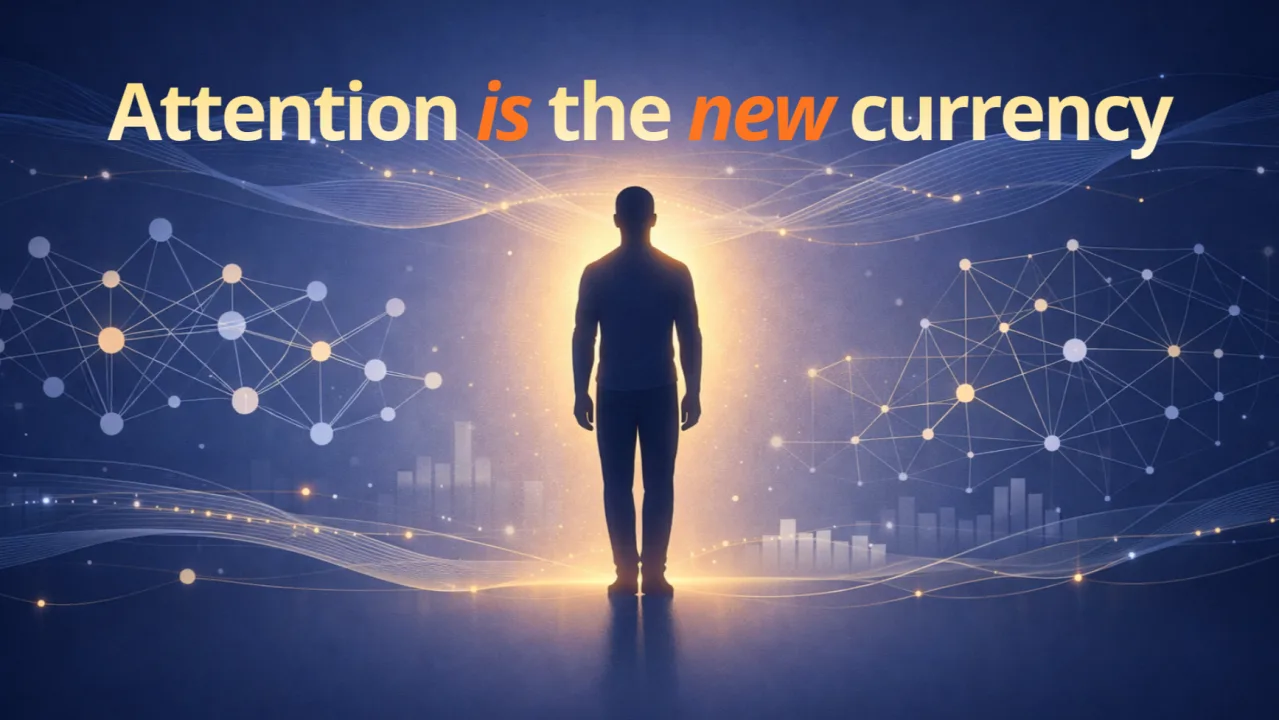
In a world where intelligence becomes cheap and scalable, the real scarcity is no longer computation, but human attention and trust.
That is why attention is no longer just a metric.
It is becoming the new currency of the economy and of management, and the ability to handle it responsibly may be one of the most underestimated, yet decisive, competitive advantages of the coming decade.