Source record
Think and Grow Rich in the Age of AI
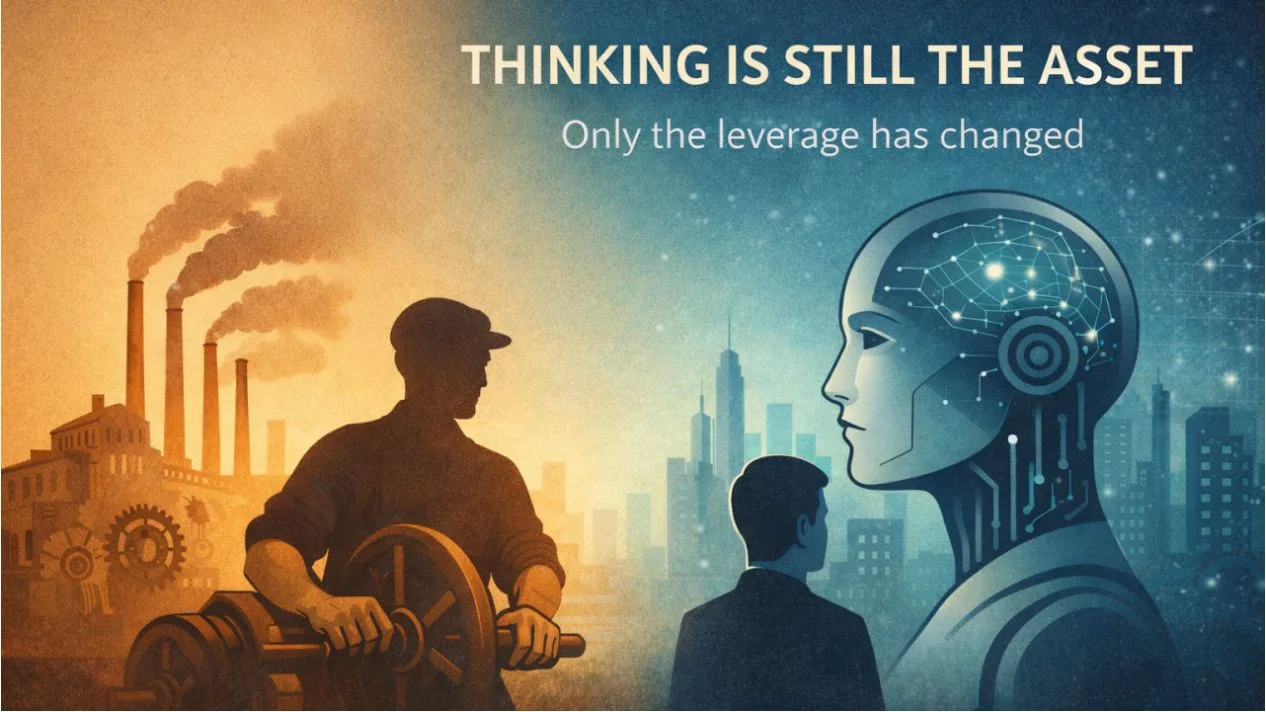
Almost a century ago, Napoleon Hill wrote Think and Grow Rich for an industrial economy. The book is often remembered as motivational, but its core thesis was far more demanding: wealth is the downstream result of disciplined thinking.
Hill was writing for a world shaped by factories, distribution networks, sales organizations, and managerial hierarchies. Yet his message was never “work harder.” It was clarify your purpose, control your attention, build competence, and compound it through the right network.
Today, the economy is being rewritten once again, this time by automation and artificial intelligence. Skills expire faster. Uncertainty is higher. And markets increasingly reward those who can learn quickly, adapt continuously, and create value that scales.
Against this backdrop, a striking pattern has emerged: millions of people have moved toward self-directed trading, often including crypto, as a shortcut to income, rather than rebuilding skills and re-anchoring their economic value in a changing world.
The question is not whether trading is “good” or “bad.” The real question is what function trading has begun to serve for the average participant.
Hill’s core principles have not aged.
They include:
a definite purpose disciplined attention persistence under uncertainty competence built over time a “Master Mind” network that amplifies thinking
What has changed is how those principles translate into economic leverage.
In the twentieth century, focus and persistence could be converted into wealth through relatively stable professional ladders and long-lived businesses.
In the twenty-first century, leverage is increasingly created through:
fast learning skill compounding systems thinking the ability to work with AI as a multiplier trust and distribution (social and product-based)
The principles are the same. The physics are not.
The recent surge in self-directed market participation is not anecdotal; it is documented.
In the United States, 46 million new brokerage accounts were opened by individual investors during 2020–2021 - an increase of nearly 80% in two years (BlackRock). In the United Kingdom, 1.15 million new accounts were opened by four trading-app firms in just the first four months of 2021 (IOSCO). The UK Financial Conduct Authority later confirmed that millions more accounts followed in subsequent years (FCA).
A mass entry clearly occurred. And a meaningful share of that energy flowed into higher-volatility, higher-stimulus arenas, with crypto markets acting as a natural magnet.
Here is the correction most “get rich trading” narratives avoid:
Consistent trading profits are not a function of courage or luck. They are a function of skill, risk management, and emotional stability.
Even Warren Buffett, who is not a trader but remains one of the clearest thinkers on market behavior, has repeated the same principle for decades:
This is not poetry. It is a warning about temperament.
In real markets, sustainable edge comes from:
probabilistic thinking strict position sizing drawdown discipline the ability to act against one’s own impulses a repeatable system that survives boredom as well as stress
Without these, trading ceases to be a profession. It becomes a psychological activity.
Markets are not money printers. They are redistribution mechanisms.
When large numbers of inexperienced participants enter a high-speed environment, three structural effects emerge.
First, retail traders compete against professionals and algorithms. Behavioral errors are predictable, and in modern markets, predictability is monetized.
Second, activity itself becomes the enemy. Decades of cross-market research show that higher trading frequency correlates with worse outcomes for individuals (UC Berkeley, Haas School of Business).
Third, the “day trading for a living” narrative collapses under scrutiny. One large empirical study of Brazilian equity futures found that among individuals who persisted for more than 300 days, 97% lost money, and only 1.1% earned more than the minimum wage (SSRN).
This is not crypto. But it reveals a deeper truth: when trading becomes frequent, emotional, and under-skilled, the base rate is loss.
Crypto adds further stressors, extreme volatility, narrative-driven price formation, and reflexive crowd behavior. The Bank for International Settlements has noted that across many economies, a majority of participants likely lost money on their bitcoin investments, based on entry-price dynamics.
At this point, the story becomes less financial, and more human.
Regulatory research shows that many participants treat crypto explicitly as a gamble, while others cite day trading as a primary motivation (FCA).
This maps to a familiar psychological pattern:
When the world becomes unstable, people search for arenas where they can feel in control, even if outcomes are not controllable.
Trading offers:
immediate feedback emotional intensity identity (“I’m a trader”) dopamine loops of near-wins and reversals
At that point, the activity quietly shifts from wealth creation to stress regulation.
And that is the deeper bubble: not only inflated prices, but inflated beliefs about how many participants can extract consistent income from systems designed to punish impatience and overconfidence.
Artificial intelligence does not merely automate tasks. It hardens asymmetry.
It amplifies those who possess:
domain knowledge systems thinking discipline distribution real value creation
And it punishes “easy-path” illusions faster than ever, because the opposing side of many markets increasingly behaves like an optimized machine.
In the AI economy, wealth is less about finding a lucky bet, and more about building leverage:
skills that compound judgment that improves reputation that converts products or services that scale
This is far closer to Hill’s real message than most modern interpretations suggest.
If Napoleon Hill were writing today, he would not romanticize trading as a shortcut.
He would still insist on the same sequence:
clarity of purpose competence emotional discipline leverage through systems and networks and only then - capital
The timeless idea was never “think and get rich quickly.” It was, and remains - think clearly, build real capability, and let compounding do its work.
In the age of AI, wealth is not a bet. It is the measurable result of disciplined thinking - under new rules.