Source record
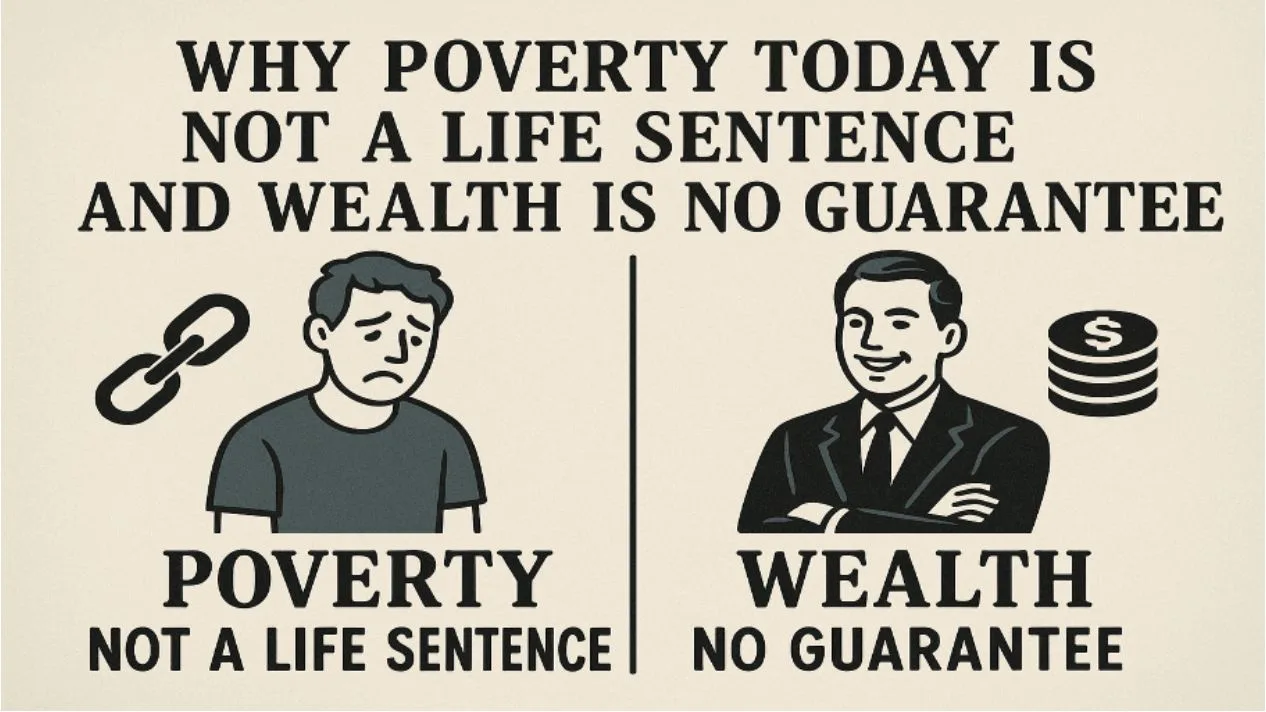
Successful or Outdated? Why Poverty Today Is Not a Life Sentence and Wealth Is No Guarantee
Are you still convinced that the rich will always stay on top and the poor forever remain at the bottom? Good news: you’re wrong. Bad news: you’re wrong. We live in an era where a coder from a remote village with a cheap internet connection can outpace the owner of a traditional business empire within a year. A taxi driver armed with online AI courses can edge out an MBA graduate. Millions are being lost not due to poverty or lack of capital, but due to complacency and a false sense of security about the future. Where do you stand in this new hierarchy? Welcome to the economy of unstable status – here there are no more castes or guaranteed positions. There is only the speed of adaptation.
Too often, people equate being poor with being powerless. In the past, being born into poverty often meant limited education, scarce opportunities, and a lifetime stuck in a low social stratum. But today poverty is no longer a life sentence; helplessness is. The difference? Poverty is a lack of money, while helplessness is a lack of will or ability to change one’s situation. In the digital age, a person with zero dollars but plenty of skills and drive can rise to success, while someone with wealth who refuses to adapt can quickly fall behind.
Consider the new breed of self-made digital entrepreneurs: the streamer who grows a massive audience from a bedroom, the freelancer in a rural town who works for clients worldwide, the crypto enthusiast who turns a few hundred dollars into a fortune. These are not fairy tales; they are increasingly common stories. Access to the internet and knowledge has leveled the playing field in unprecedented ways. For example, the creator economy has exploded – the top content creators online now earn incomes rivaling or exceeding those of CEOs and Hollywood stars. The highest-earning TikTok influencer, Charli D’Amelio, reportedly made $17.5 million in a single year, which is more than the median pay package of CEOs running S&P 500 companies. In other words, a teenager dancing in her living room can out-earn a Fortune 500 executive.
And it’s not just influencers. Cryptocurrency and online entrepreneurship have minted thousands of new millionaires from ordinary backgrounds. A 2024 report estimated there are now about 173,000 cryptocurrency millionaires globally, including over 85,000 who made their wealth from Bitcoin. Many of them started with small, modest investments and leveraged early knowledge of a new technology to create massive wealth. In earlier generations, wealth came from property or inheritance; today it might come from coding a hit app or buying the right digital asset at the right time. Staggering returns are being made from relatively small amounts of initial capital in the crypto and tech space – something that would have been unimaginable in the old industrial economy.
A former taxi driver retrained as a software developer, now earning three times his previous income thanks to digital skills. In the digital economy, a “low” starting point is not a permanent disadvantage if one is willing to learn and adapt.
The rise of upskilling stories underscores that poverty doesn’t have to be permanent. Take the case of Gazali Ahmad in Singapore: at 45, he was driving a taxi and feeling stuck, but by his early 50s he had completed a 9-month coding bootcamp and landed a job as a software engineer making three times what he earned before. His story is just one of many. Around the world, people with minimal resources are using online courses, coding bootcamps, and freelance platforms to vault into new careers. What separates those who succeed isn’t the size of their bank account at birth – it’s their willingness to seek out knowledge and new skills. Being poor is not a dead-end unless you allow it to be.
On the flip side, consider those who had it all and lost it because they failed to adapt. History is rife with once-dominant figures and businesses that fell from glory by clinging to old ways. Blockbuster’s executives laughed off Netflix’s internet-based model – now Blockbuster is extinct and Netflix is a multi-billion-dollar giant. Kodak invented the digital camera but resisted embracing it for fear of hurting their film business; they went from industry king to bankruptcy by 2012. These cautionary tales aren’t just about companies – they reflect individual mindsets as well. A successful restaurant chain owner or retail magnate who dismisses online trends, delivery apps, or social media marketing could see their fortune evaporate as agile upstarts capture the new generation of customers. In today’s world, wealth can disappear if it’s managed with a stagnant mindset.
The bottom line in this new landscape is: being born poor is not an excuse, and being born rich is not a guarantee. What matters is whether you treat your circumstances as fixable. Poverty is no longer a permanent predicament, but refusing to learn and adapt is a sure path to failure. Helplessness – the belief that you cannot change or that you have nothing to learn – is the true danger.
If money isn’t the barrier it once was, what is? Knowledge. In the 21st-century economy, your ideas, skills, and ability to learn are far more valuable than cash in the bank. Capital can dwindle or get outpaced, but a clever idea or a valuable skill can attract new wealth like a magnet. It’s why we see bizarre role-reversals: a TikTok chef with just a smartphone and Wi-Fi can earn more than a seasoned corporate lawyer, or a popular YouTube educator can make more than a doctor. Money follows talent and knowledge now, not the other way around.
In fact, traditional markers of wealth and success are being upended by this new reality. A fancy degree or a fat starting investment might have been necessary to get ahead decades ago, but now we see high school dropouts building tech companies and content creators monetizing their hobbies. Knowledge and creativity have become a form of currency – one that can appreciate rapidly. A person with the right expertise can raise capital through crowdfunding or attract a massive online following; their ideas literally generate money.
Let’s look at a concrete example: online content creation. The internet has enabled anyone with knowledge or passion to share it with the world and potentially monetize it. There are chefs who post cooking videos, teachers who tutor on Zoom, gamers who stream their play – and some of these individuals are earning staggering incomes. According to recent figures, the top YouTube creators make tens of millions per year, and TikTok’s top 5 creators each earned between $5 million and $17.5 million in a year. These earnings are on par with or higher than what partners in top law firms or executives in large companies make. A Yahoo Finance analysis even noted that Charli D’Amelio’s estimated TikTok earnings of $17.5M were greater than the median CEO salary of S&P 500 companies (roughly $13–14M). Think about that: a teenager with creative dance videos overtook the pay of corporate America’s elite. If that doesn’t illustrate “knowledge (or creativity) is the new currency,” what does?
The phenomenon isn’t limited to entertainment. Open-source knowledge and online learning have dramatically lowered the barrier to entry for high-paying skills. Want to learn to code? You can do it online often for free. Want to master digital marketing, graphic design, or data analytics? Countless tutorials and courses are at your fingertips. The only real cost is your time and effort. People around the world are seizing this opportunity. For instance, an analysis by the World Bank highlighted how even a small, landlocked country like Kosovo sparked a digital freelancing revolution by expanding internet access – enabling youths in villages to work online and compete globally. When knowledge is accessible, a smart and motivated individual can bootstrap themselves from zero to success faster than ever before.
Meanwhile, those who sit on piles of “old money” but don’t invest in learning new things find their advantages slipping. An inherited business or wealth can evaporate if it’s not managed with knowledgeable decisions. We’ve seen wealthy retail chains go under because management didn’t understand e-commerce, and highly-paid professionals become redundant because they didn’t keep up with tech skills. Knowing how to learn may be the most important skill of all.The truly wealthy in the new economy are those rich in ideas and adaptive intelligence.
This provocative statement rings true when you consider that static wealth is vulnerable, but a dynamic mind keeps generating value. A person with an expensive home and a prestigious diploma who isn’t continually updating their skills might wake up a decade later to find their industry gone or their expertise outdated. In contrast, someone with none of those initial perks but with hunger to learn might create a new product or master a new platform that changes their financial destiny. Your knowledge base and skill set – and your ability to expand them – are now the truest measures of wealth. Money itself is just an output.
Clinging to the old ways is a recipe for losing everything. Many of yesterday’s rich and powerful are learning this the hard way. The new economy – digital, fast-moving, and disruptively innovative – doesn’t care how big your bank balance is if you can’t adapt. In fact, large fortunes can become large vulnerabilities if they tie you to legacy thinking. It’s like having a huge castle built on sand; it looks solid until the ground shifts underneath.
One pattern we see is wealthy individuals or companies doubling down on “old money” habits – investing only in offline businesses, relying on brand legacy, insisting on hierarchies and tradition – and getting blindsided by nimble newcomers. Consider the retail sector: giants like Sears and Toys'R'US, once bolstered by decades of success and strong brand recognition, collapsed when they failed to innovate against online competitors. Their wealth and past glory couldn’t save them from bankruptcy when customer behavior changed. By contrast, new rich entrepreneurs who embraced e-commerce, digital marketing, and data analytics rose to take their place.
Sticking with comfortable habits can be especially dangerous for the wealthy because success can breed complacency. Psychology and business studies both note this paradox: the more successful you are, the harder it can be to question the formula that made you successful. Yet change is relentless. As one analysis put it, failure to adapt was the downfall of even iconic companies like Eastman Kodak Company, Blockbuster, and Nokia, underscoring the “catastrophic consequences” of technological complacency. Old money often falls victim to the illusion that “if it isn’t broken, don’t fix it,” while new challengers are busy reinventing the game.
So, who are the “new rich” and why are they so different? Today’s new success stories often involve hybrid talents and interdisciplinary thinkers. It’s no longer enough to be just one thing – just a coder, just a marketer, just a business manager. The people thriving now wear multiple hats and combine skill sets in unique ways. Picture a programmer-marketer who can both develop a software product and craft a campaign to sell it; or a psychologist-turned-AI-analystwho uses insights from human behavior to train better machine learning models. These hybrids are extraordinarily valuable because they bridge worlds. They innovate at the intersections of fields, which is where a lot of new value is created.
A great example is the rise of tech-savvy influencers and educators. A fitness coach might also become an expert in NFT platforms, turning workout plans into digital collectibles. A psychologist might learn data science and start using AI tools to offer personalized therapy at scale. A traditional real estate agent might become proficient in social media and dominate their market via Youtube and TikTok tips. These combinations were rare or unheard of a generation ago, but now they’re becoming the norm among top performers. The new economy rewards breadth and flexibility. The more of these “hybrid” skills you have, the more ways you can create value and pivot when needed.
Meanwhile, those who inherited their skills or wealth in a single domain – say, a third-generation owner of a famous family brand – might find themselves outclassed by a hungry newcomer who mixes talents. For instance, a famous luxury fashion house can lose ground to a no-name startup that masterfully uses technology (like AI-driven designs or viral marketing via influencers) that the old guard ignored. Wealthy incumbents often underestimate how quickly their advantages can evaporate. The COVID-19 pandemic was a rude wake-up call: companies and wealthy business owners who “kept to their offline models” saw massive losses, while those who pivoted to digital channels often gained even more. As one venture capitalist observed in early 2020, the pandemic massively accelerated the shift from offline to online, and “many will lose a lot, if not everything” by the end of this transformation if they fail to adjust. That statement was prescient – by 2022 and 2023, we indeed saw entire sectors (travel, brick-and-mortar retail, traditional restaurants) shaken up, with winners being those who embraced change (video conferencing, e-commerce, food delivery apps) and losers being those who didn’t.
In short, old money can quickly become “outdated money.” The new economy has reset the game, and it favors the agile. Riches built on inflexibility and nostalgia will crumble, while wealth built on learning and innovation will multiply. The new rich are often self-made, yes – but more importantly, they are self-updating. They treat past success as a stepping stone, not a couch to rest on.
In the past, starting from zero was a huge disadvantage. If you had no capital, no connections, no prestigious credentials, you were unlikely to break into the upper class. But now the game has fundamentally reset. A zero start is no longer a minus if you know how to learn fast. In fact, coming from nothing can even be an advantage in a world that changes so fast – you have nothing to lose and everything to learn.
Think of the economy as a video game that just had a massive update; everyone’s old high scores have been wiped, and new strategies are needed to win. Those who were winning with old strategies (like relying on pedigree or protected markets) are finding their power-ups gone. Meanwhile, those who are quick to download the latest “patch” (new skills, new tools) can sprint ahead. In this updated game, privilege and traditional advantages are worth a lot less. Sure, having money or a degree or family connections can still open doors, but it doesn’t guarantee you’ll stay ahead. The pace of change is simply too high. A fancy degree might become obsolete knowledge in a few years; money invested poorly can vanish; connections can’t save you if your industry transforms and you don’t.
One striking trend is how employers themselves are shifting to value skills over pedigree. A recent survey found that in 2023, 55% of companies removed college degree requirements for many jobs, preferring to focus on skills and experience. By 2024, nearly half of employers said they plan to eliminate bachelor’s degree requirements for even more roles. Why? Because even businesses recognize that a degree isn’t a reliable marker of capability in this fast-moving world – there are “other ways to gain skills” now, from online certifications to practical project experience. Major corporations like IBM, Wallmart and Bank of America, and others have announced that they’re dropping degree requirements to widen the talent pool and catch those who learned their craft in non-traditional ways. When the gatekeepers stop gatekeeping the old way, it’s a clear sign that the rules of the game have changed. Your ability to learn and adapt on the fly is your new entry ticket.
What does this mean for individuals? It means that if you’re starting from zero, you shouldn’t be discouraged – you should be excited. You can learn almost any skill online, prove yourself through real-world projects or content, and get recognized without needing someone’s permission or a golden credential. It also means if you do have a head start (wealth or degrees), you can’t rest on it. A sobering statistic for complacent “old winners”: 80% of employers say they are likely to favor a candidate’s relevant work experience and skills over education level when hiring. That MBA or family business may have gotten you in the game, but it won’t guarantee you level-ups unless you keep acquiring new abilities.
Zero start no longer means zero chance. In fact, we’re seeing a renaissance of entrepreneurial spirit and lifelong learning. People in their teens to their sixties are reinventing themselves. A mid-50s ex-taxi driver can become a high-paid coder (as we saw); a factory worker can learn digital marketing and open a successful online shop; a retiree can start a consulting gig on Zoom. The barriers that once kept people “in their place” are eroding. Libraries of knowledge are a click away, and even capital can be crowdsourced if you have a compelling idea. The key is mental flexibility and grit. Those who treat every day as an opportunity to learn something new will thrive. Those who cling to “I’ve always done it this way” will find themselves with shrinking opportunities.
The reset also implies that privilege is being redefined. Instead of viewing privilege solely as what family or money you’re born into, think of privilege now as access to information and the capacity to adapt. Someone born wealthy but technologically illiterate may actually be less privileged in this new economy than someone born poor but internet-savvy and hungry to improve. The first person might sleep on their advantages and watch them decay, while the second person seizes every free online course and market trend to build something new. It’s almost a reversal of fortunes in many cases.
As the dust settles on this upheaval, a new form of inequality is coming into focus – a mental inequality. This is not measured by the size of one’s bank account or the neighborhood one lives in, but by one’s mindset and ability to change. The real gap now is between those who can adapt, learn, and stay curious versus those who cannot or will not. In a world where technology, markets, and society evolve at breakneck speed, being adaptable is the new elite trait.
This “mental elite” isn’t defined by aristocracy or Ivy League degrees; it’s defined by traits like digital literacy, creativity, and resilience. Digital literacy is crucial because virtually every industry has a digital component now. According to research by the U.S. Federal Reserve and National Skills Coalition, a whopping 92% of all jobs now require some level of digital skills. If you lack those skills, you’re effectively shut out of a huge portion of the economy – or stuck in the lowest-paying tiers of work. Indeed, jobs that require even one or two solid digital skills pay significantly more. One analysis found that jobs requiring at least one definite digital skill pay about 23% more on average (roughly $8,000 extra per year) than similar jobs with no digital skill requirement. Each additional layer of tech skills bumps the wage higher. In other words, knowing how to use technology is directly translating into higher income, much more so than traditional factors. The new upper class are those fluent in the language of the digital world.
Digital skills have a direct impact on earnings. As the number of required digital skills for a job increases (from none on the left to several on the right), the median wage rises dramatically. Adaptability and continuous learning translate into real economic advantages.
But mental inequality goes beyond just knowing tech. Creativity – the ability to think of novel solutions and ideas – has become a prized asset. Why? Because automation and AI can handle routine tasks, but creative, human thinking drives innovation and differentiates us from machines. Those who can combine human creativity with tech tools can produce content, businesses, and solutions that stand out. They become trendsetters, not followers. Consider how important creative skills are even in technical fields: data analysts who can creatively visualize and communicate insights, or engineers who can think outside the box to solve problems, are far more valuable than those who just churn out rote work.
Adaptability and a growth mindset tie it all together. Alvin Toffler, a futurist, famously said: “The illiterate of the 21st century will not be those who cannot read and write, but those who cannot learn, unlearn, and relearn.” In a single sentence, he captured the essence of mental inequality today. The new “illiterate” are those who stop learning. Conversely, the new “elite” are those who remain lifelong learners. They’re the ones picking up new skills in their free time, experimenting with new technologies, and staying curious even if they’re already successful. This mental agility means they can slide into new opportunities as old ones fade. They don’t fear change; they expect it and even seek it out.
What about those on the other side of the divide? The people who assume that what they know now will last forever, or who find learning new things too uncomfortable? They may enjoy a comfortable position for a time (perhaps due to past success or an existing safety net), but they are on a ticking clock. If you’re not upgrading yourself, you’re slowly downgrading your future prospects. We’ve already seen how entire professions can become obsolete. The shelf-life of skills is shortening – some technical skills become outdated in a few years if not refreshed. Even non-technical careers face upheaval (for example, an attorney who doesn’t stay current with e-discovery technology or AI could struggle against more efficient peers). Thus, those who treat education as something that ended at graduation are falling behind those who treat every day as a school day.
This new inequality is tricky, because it’s not immediately visible like a mansion or sports car. It manifests in how ready people are for sudden changes. When a new software, platform, or economic shift comes, the adaptable quickly leverage it (and maybe profit from it), while the inflexible scramble or deny that it’s happening. In times of disruption, the gap widens dramatically. We saw this during the pandemic: workers who could pivot to digital modes (remote work, e-commerce, etc.) often kept or even improved their income, while those without digital skills faced unemployment or hardship. It wasn’t just wealth or class – it was the skill and mindset gap determining outcomes.
So ask yourself: which side of this mental divide are you on? Are you actively learning and evolving, or are you coasting on yesterday’s knowledge? In this world, coasting means sliding backward because the environment is moving forward. The new inequality may not yet have the same visibility as income inequality, but it underpins it. Digital literacy, creativity, and adaptability are the new markers of an upper class – a class open to anyone with the right mindset.
Nothing in this new world is guaranteed. Not your salary, not your diploma on the wall, not the nest egg your parents left you. The only thing you can count on is change – and your response to it. The dichotomy of “successful or outdated” has nothing to do with where you started, and everything to do with whether you keep moving.
We began by asking if you still believe the rich will stay rich and the poor stay poor. By now, it should be clear that wealth and status have never been more volatile. Today’s nobody can become tomorrow’s breakout success. Today’s success story can become tomorrow’s outdated news. The deciding factor is not the balance in your bank account, but the balance in your “skill account” – are you adding to it, or letting it deplete?
Take a moment to reflect on yourself: Do you define your “class” by your income or by your mindset? If it’s by income alone, that’s a snapshot in time – it can change in a flash. But if you define it by mindset, you have control. You can choose to think like the new elite: stay curious, stay humble, stay hungry. Every day is an opportunity to learn something that keeps you in the game.
So, what did you do today to not become an outdated success story tomorrow? Did you pick up a new skill, read something outside your comfort zone, experiment with a new tool? Or did you rest on the laurels of what you already know? The harsh truth of the new economy is that stagnation is the real poverty. You could have a million in the bank, but if you’ve stopped growing, you’re one disruption away from irrelevance – the “new poor” with an iPhone but no plan, as the saying goes. Conversely, you might have very little materially right now, but if you’re constantly upgrading your mind, you are investing in an asset that appreciates and can never be taken away by market crashes or twists of fate.
In this era of unstable status, the only stability comes from within – your willingness to adapt. The safety net is not your job title or your savings account; it’s your capacity to reinvent yourself. We are all students and startups now, no matter our age or wealth. The economy rewards those who treat themselves as a work in progress.
So the final and only guaranteed question you must keep asking is: What have I learned today, and what will I learn tomorrow? Because in the new world, if you’re not learning, you’re voluntarily stepping to the sidelines. And life on the sidelines of this new world – that is true poverty. Stay in the game, stay adaptable, and you’ll find that success is not a trophy you win once, but a continuous journey of growth. Successful or outdated? The choice, more than ever, is yours.
Rory Gilbride Reflects on how embracing uncertainty can fuel personal growth.