Source record
The Art of Lying: Why Everyone Lies and What It Means for the Future
“Everybody lies.” It’s the gospel according to Dr. Gregory House, the misanthropic TV doctor who could smell a fib a mile away. And he’s not wrong – deception is practically a defining trait of being human.
We compliment hideous sweaters, feign being “on our way” when we haven’t left home, and nod along to boring stories as if utterly riveted. In fact, research suggests the average person utters one to two lies per day. Congratulations, that means you’ve probably lied to someone in the last 24 hours (and if you insist you haven’t, well… that might be a lie too). But don’t pat yourself on the back for honesty just yet – those are just the little white lies. A small fraction of prolific liars are doing most of the heavy lifting (or lying) in our society, with only 5% of people responsible for half of all lies told. Think of it as the 1% rule but for dishonesty: a few bad actors are out there spinning extravagant falsehoods while the rest of us stick to polite fibs.
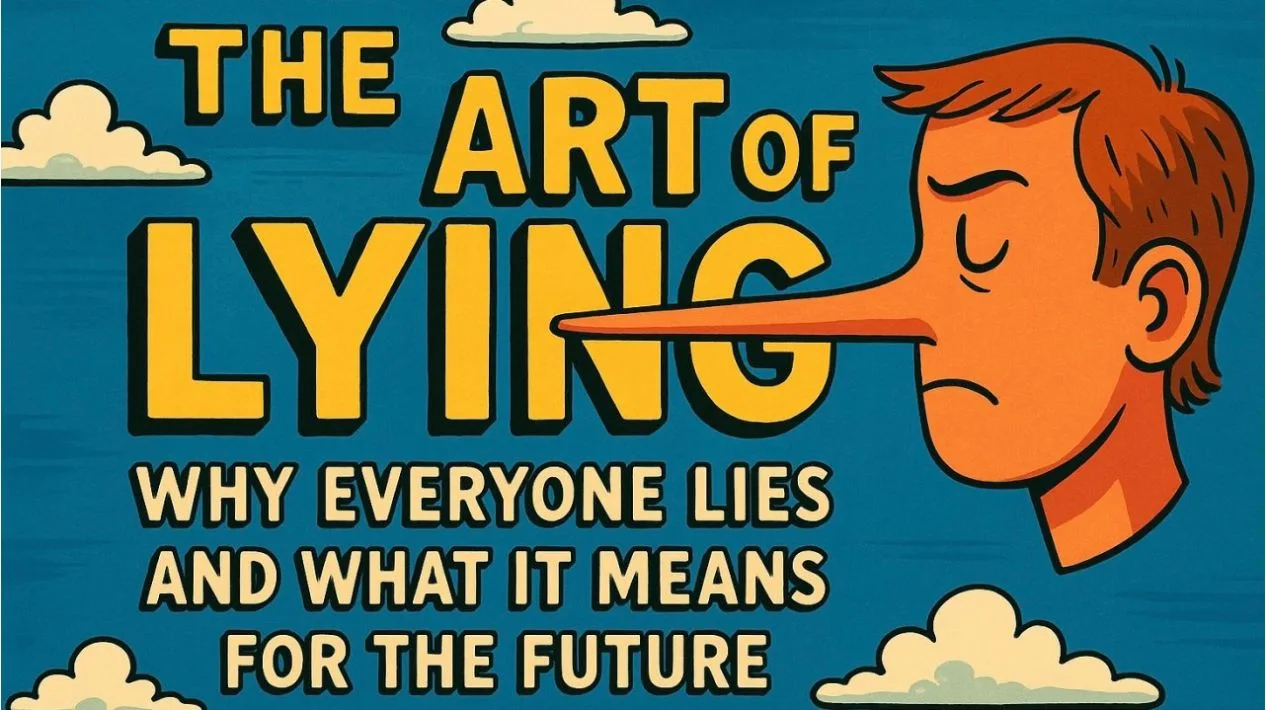
We don’t have Pinocchio’s tell-tale nose to give us away, but that doesn’t stop us from fibbing through our teeth on the regular. We may not sprout a wooden nose like Pinocchio, but humans have mastered the art of fibbing in ways both trivial and grand. Why do we do it? Are we proud members of some secret “Liars Anonymous” club, or is lying just an evolutionary survival skill? And as we hurtle into a high-tech future of deepfakes and AI mind-readers, what happens to our beloved art of lying? Buckle up – it’s time to dissect the psychology, the tech, the fallout, and the future of our most human pastime: not telling the truth. (Don’t worry, this will be our little secret.)
Let’s start with the basics: why do we lie at all? What’s the psychological payoff for all these fibs and fabrications? At its core, lying is often a coping mechanism. One common driver is fear – fear of punishment, fear of judgment, fear of hurting someone we care about. Did you ever break a vase as a kid and blame the cat? (Sorry, Whiskers.) That was fear of consequences whispering in your ear: “Deny, deny, deny!” Or consider adults lying on tax forms or in job interviews; the fear of missing out on a benefit or being deemed unqualified prompts many to “massage” the truth.
Then there’s shame. People lie to cover up things they’re ashamed of – whether it’s an embarrassing mistake or a personal insecurity. If admitting the truth threatens our self-image, a lie can act as a momentary shield. We fudge the story of why a relationship ended, or we “forget” to mention being fired from a past job, all to avoid the sting of shame.
And of course, there’s the desire for control. Telling the truth can make us feel vulnerable; lying lets us steer the narrative. When reality isn’t going our way, why not construct a more favorable version? Lying can be a power move – a bid to control how others see us or to influence a situation to our advantage. Politicians caught in scandals, CEOs covering up failures, or an insecure friend who boasts with wild exaggerations all share this in common: they lie to control the story.
Sometimes it’s about protecting ego (“I totally bench-pressed 250 lbs – must’ve been the gym’s faulty equipment that day I looked weak, honest!”), and other times it’s about manipulating others (“No, really, if you send me $5,000, I promise I’ll pay you back double next week.”). Lying often sprouts from a toxic mix of fear of the truth and hope that a lie will yield a better outcome. Before we judge too harshly, note that not all lies are born equal. There’s a big difference between malicious deception and so-called “white lies.” Telling your friend that their painfully awkward karaoke performance was “Amazing!” when it was anything but – that’s a lie born from kindness (and maybe a pinch of please-don’t-hate-me fear) to spare their feelings. In contrast, claiming you have a PhD you never earned to land a job is a self-serving lie born from ambition and control. We learn early that truth can be flexible. By adulthood, bending it becomes second nature. Is that horrifying or just practical? It depends – would society function if everyone blurted out the whole truth all the time? (Imagine if every “How are you?” was answered with a detailed breakdown of someone’s aches, pains and existential dread. You’d run out of the room.)
Psychologically, humans are quite adept at rationalizing lies. We tell ourselves the lie is for the greater good, or that everyone else is doing it. Often, lying is a quick fix to navigate social dilemmas: we lie to avoid conflict, to be polite, to sidestep awkwardness. Have you ever responded “I’m fine” when you were definitely not fine? We lie to fit in or to avoid standing out. Fear of rejection can push a person to agree with opinions they secretly disagree with, essentially lying about their true thoughts. We lie out of shame about our flaws, fear of losing respect, and sometimes simply because we can. As one researcher put it, “Telling a convincing lie requires cognitive effort.” It’s a mental skill – though perhaps not one to brag about on your résumé (unless you’re running for office, in which case it might be a prerequisite). At the end of the day, we lie to others for the same reasons we lie to ourselves: to protect, to control, to avoid pain. Yes, self-deception is a huge (and fascinating) part of lying. We often believe our own lies if it makes us feel better – a topic for another day.
But for now, let’s keep focus on the external lies and how our modern world is transforming them into something far more complex (and in some cases, downright dystopian).
Our parents lied in person and over landline telephones. We lie on Instagram, TikTok, dating apps, 24/7 group chats, and every digital medium available. Welcome to the culture of curated perfection, where lying has practically become a competitive sport.
Social media, in particular, has turned us all into mini spin-doctors, presenting highlight reels of our lives and conveniently editing out the blemishes. Who hasn’t cropped out the pile of dirty laundry just off-camera before snapping that “candid” selfie? Is it lying to apply a flattering filter or only share the exciting parts of your year? It certainly isn’t radical honesty.
We’re effectively living lies online – constructing a persona that may only loosely resemble reality. There’s even an entire trend of people faking luxurious lifestyles: some influencers rent fake private jet sets just to pose for “baller” Instagram photos. Consider online dating – a veritable lying Olympics. Profiles are full of “truth-stretchers.” That 6’0” tall guy? He’s 5’9” in person. The woman with “slim athletic build” might have taken some creative license with old vacation photos. Surveys find a large share of online daters lie about something – age, height, weight, income, even relationship status.
One U.S. survey in 2024 found about one in five online daters lied about their age on their profile. Even business and career culture incentivize some fibbing. We have fancy terms like “résumé padding” or “professional spin.” A startling number of people have admitted to lying on their résumés or in job interviews – tweaking job titles, inflating accomplishments, claiming skills they don’t really have.
Over 75% of employers say they’ve caught applicants lying on résumés in some form. Let’s not forget healthcare, another arena rife with lies – but here, the lies often go toward the authority figure. Studies show between 60% and 80% of patients withhold or distort information to their clinicians. Fear and shame drive the deception – they don’t want to be judged.
Our entire culture dances around the truth, deciding when lying is acceptable (polite white lies, strategic half-truths) and when it’s monstrous. And technology has poured jet fuel on this fire. Enter the era of AI-assisted lying – deepfakes and beyond. In 2023, an eerie deepfake of actor Tom Cruise went viral on TikTok, fooling even some detection algorithms. The lines between truth and lie have never been blurrier. On social media, misinformation spreads like wildfire. In the post-truth era, lying isn’t just an individual habit, it’s a collective crisis. Entire communities sometimes rally around shared lies.
Are we building a future where lying is the default and truth the rarity?
For as long as humans have lied, other humans have tried to detect lies. From medieval trials by ordeal (“If she floats, she’s lying!”) to the classic polygraph machine, we’ve sought a foolproof way to sniff out deception. Thus far, perfect lie detection remains as elusive as honest politicians. But fear not (or perhaps, fear a lot): the future promises new lie-detection tech that borders on sci-fi.
Researchers are training AI algorithms to analyze micro-expressions, vocal tone, and typing patterns for signs of deception. Governments have piloted automated border-security kiosks that ask travelers questions while an AI watches their face for the tiniest “tells.” It doesn’t stop there.
Brain-scanning technology is lurking on the horizon. Some neuroscientists have experimented with fMRI-based lie detection, claiming accuracies upwards of 90% in lab settings. Are we ready for a world where privacy ends at the skull? Meanwhile, as lie-detection gets more advanced, so do the lies. AI deepfakes and AI language models can generate fabricated texts en masse. It’s an arms race: high-tech liars vs. high-tech lie detectors. If history is any guide, liars are always a step ahead. Culturally, we’re also wrestling with the morality of lying in a new way.
Some futurists even ponder if we could engineer humans to be more honest – through brain-computer interfaces or gene editing. Could technology inadvertently force us toward honesty? Or create a liar’s paradise?
Ask yourself: Would you want a personal gadget that alerts you when someone lies to you? Lie-detection could become the next must-have wearable. But do we really want that power? The truth can be brutally inconvenient.
What is the impact of all this lying on our relationships, careers, and sense of self? Trust is the bedrock of any healthy relationship, and lying is the jackhammer that can shatter it.
One lie often necessitates more lies – the classic snowball effect. In careers, lying can offer short-term wins but long-term ruin. Many a career has imploded when a high-profile lie was exposed (hello, Elizabeth Holmes and Lance Armstrong).
Honesty really is the best policy – except when it isn’t. Each lie we tell is like adding a new mask over our face. Chronic liars sometimes get lost in their own web; maintaining multiple false stories is mentally exhausting. Lying can create stress – your body knows it’s doing something “wrong” and kicks up cortisol. People who reduced everyday lies reported better mental health and relationships. There’s also a moral aspect. Every lie is a small erosion of integrity. Conversely, telling tough truths often builds confidence and character.
Should we all just stop lying, cold turkey? Would a perfectly honest world be a utopia or a nightmare? Complete honesty can be brutally abrasive. Politeness is often just controlled lying.
Is any lie justified?
Many would say yes – lies told out of kindness or to prevent greater harm. Fiction, satire, and storytelling are beautiful lies we all embrace. Transhumanists might dream of engineering away deceit, but must contend with the value of benevolent deception. Perhaps the answer lies not in abolishing lying, but in lying better – sparingly, for the right reasons. As we stand on the edge of a future where AI might expose every fib or fabricate new ones, it’s worth reflecting on our relationship with truth. Maybe the most radical act is telling the truth – when it matters most. So, are you lying to yourself about not being a liar? Think about it. In a world where everybody lies, the next time someone asks “How are you?” you’ll have a split-second decision to make.
Whatever you choose, remember: lying is an art we all practice, and like any art, it reflects who we are – the good, the bad, and the Pinocchio inside us.