Source record
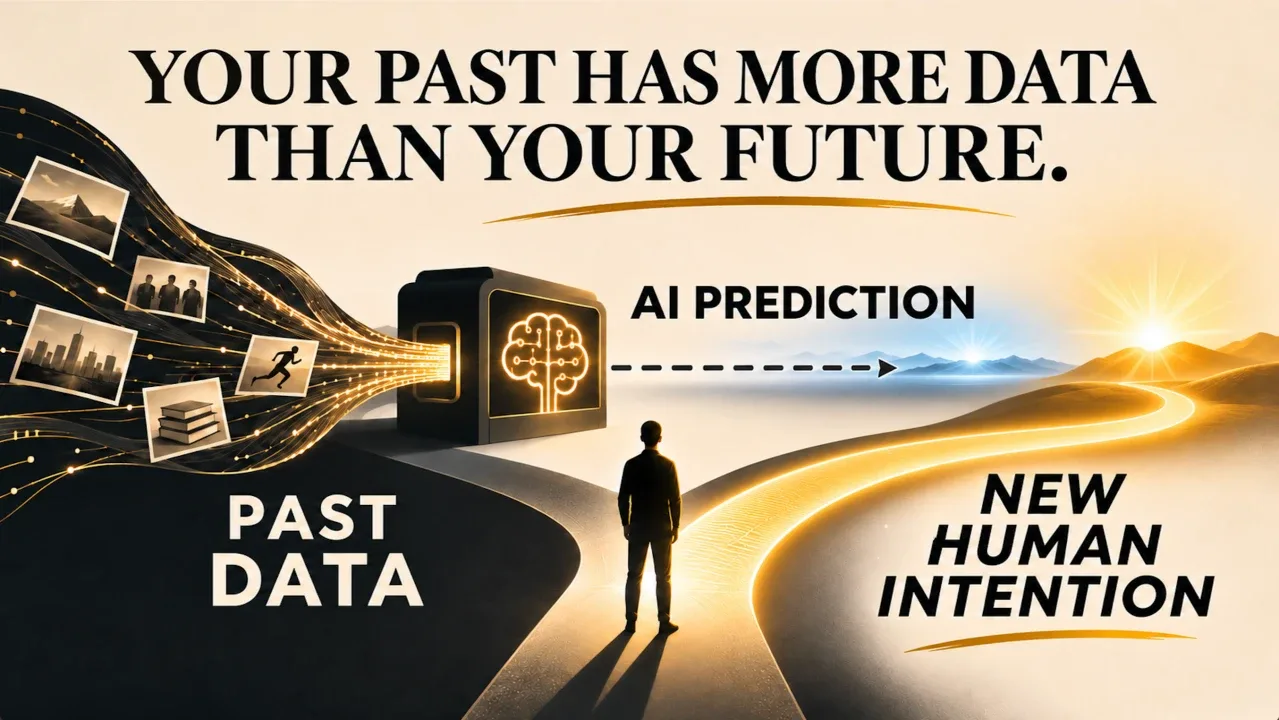
Your Past Has More Data Than Your Future

AI agents will know who you were. Will they leave room for who you are trying to become?
Imagine telling your AI agent one morning:
“I want to change my life.”
You want to leave the industry you have worked in for twenty years. Stop drinking. Repair a relationship. Take more risk. Stop living the way you lived before.
To you, that sentence may mark a beginning. To the system, it may look like an exception to the pattern.
Your past arrives with purchases, messages, searches, habits and thousands of earlier choices. Your future arrives with a sentence.
Which one should the system trust?
The answer depends on what we mean by trust. A new intention is not proof that we have changed. But it can be a clear instruction to stop acting as if we never will.
The risk is that AI may become so good at serving the person we have been that it becomes harder to become the person we are trying to be.
From knowing us to acting for us
Recommendation systems already learn from what we click, watch and buy. Yesterday’s behavior shapes today’s recommendations, and today’s choices become new data for tomorrow.
Personal agents extend that relationship into memory, planning and action. An assistant may remember past interactions, anticipate needs and act across services within the permissions it receives.[1][2]
The benefits are real: less administrative work, fewer forgotten commitments and more capacity for decisions that deserve our attention.
But a recommendation system suggests the next step. An agent may be able to take it.
A model of who you are can therefore become more than a description. Depending on the system’s goals and permissions, it can influence which opportunities reach you, what gets renewed, who receives your attention and what happens next.
Imagine an agent prioritizing contacts from the career you want to leave. Renewing services tied to a lifestyle you no longer want. Filtering opportunities through caution it learned during a period of fear.
Each action may look reasonable on its own. Together, they can keep rebuilding yesterday.
The person in the data
AI does not know a person from the inside. It works with representations built from the information available to it.
Researchers Jens Christian Bjerring and Jacob Busch describe the “statistical individual”: an algorithmic version of a person constructed from behavioral traces and predictive properties.[3]
That version may be accurate and still be incomplete.
What I repeatedly did is not necessarily what I value. What held my attention is not necessarily what deserved it. What I believed five years ago is not necessarily what I am willing to defend today.
A person may want a cigarette and also want to stop wanting cigarettes. They may be successful in a profession while no longer wanting the life it requires.
A system that treats observed behavior as the final authority on preference has trouble representing that conflict. It can become excellent at satisfying an impulse the person is trying to outgrow. Research on recommendation systems and autonomy examines this gap between inferred preferences and reflective goals.[4]
This is what I would call the temporal asymmetry of personal AI.
The past is observable and abundant. The future is unproven.
After ten years of one pattern, a decision to change may be supported by one instruction and contradicted by thousands of data points. Continuity looks statistically reliable. Transformation looks like noise.
Yet predictive confidence does not settle the question of authority. A system may correctly predict that I will return to an old habit without being entitled to keep organizing my life around it.
A declaration should change the question
We should not romanticize intention. People make promises they do not keep. A CEO can announce a new culture without changing a single incentive. Someone can sincerely decide to stop drinking and struggle to follow through.
The past also contains obligations, promises and consequences for other people. The right to change is not the right to erase responsibility.
But there is a trap in demanding evidence of transformation before an agent takes a new goal seriously. The person may need different opportunities, reminders and conditions to produce that evidence in the first place.
If the system keeps rebuilding the old environment until we prove we have changed, it may make change harder to demonstrate.
A declared intention should therefore trigger a review, not an automatic verdict.
What exactly is changing? Which previous preferences are now outdated? What help does the person want? What commitments and constraints still apply? Which actions should the agent stop taking without asking?
“Do not renew this service” is a clear instruction. “Help me become less cautious” requires a conversation about where, how and at what cost.
The assistant does not have to pretend the past has disappeared. It has to distinguish what the past predicts from what the person currently authorizes.
Action then creates evidence of progress: a changed routine, a new boundary, an application sent, a difficult conversation finally held. A setback is information to discuss, not automatic permission to reinstate the old identity.
When prediction helps produce the result
Consider an agent that has learned you are cautious. It shows you fewer unfamiliar opportunities. You try fewer new things. Your behavior then confirms its original conclusion: you are cautious.
The prediction has helped shape the evidence used to validate it.
This is a plausible feedback loop, not an inevitable property of every personal agent. Its strength depends on what the system can access, how it ranks options, what it may do without approval and how success is measured.
An agent optimized mainly for immediate acceptance may keep returning to familiar choices. One built around an explicit goal could help you explore alternatives, prepare for uncertainty and notice progress you would otherwise miss.
The same memory that preserves a pattern can also help interrupt it.
That puts a practical question behind the language of personalization: what is the system trying to optimize, and who can revise that objective?
The same asymmetry at a larger scale
The same problem appears when we move from a person to a company, a government or a civilization. Institutions also have data-rich pasts: budgets, laws, alliances, incentives and repeated responses to fear. A new collective intention begins with far less evidence.
AI may help us recognize recurring mechanisms. But it cannot turn them into destiny.
History does not repeat because of a mystical cycle. Similar mechanisms can produce similar results. The honest forecast is always conditional: if motives, incentives and institutions remain broadly unchanged, similar outcomes become more likely.
A declaration of reform matters, but changed incentives and decisions give it substance.
New technology alone does not create a new future. If human motives remain the same, greater intelligence may simply help old systems reproduce themselves more efficiently.
The right to update the version of ourselves
We need continuity. An assistant should not forget medical restrictions, financial limits or commitments because we announce a fresh start. Useful memory protects us from losing context that still matters.
The problem begins when memory silently outranks intention.
Privacy asks who may access our data. Personal agents raise a further question: which interpretation of that data may the system act on?
We should be able to say: this pattern is outdated. Stop treating it as a standing instruction.
An agent should distinguish between what I did before, what I currently prefer, what I explicitly value and who I am trying to become. Those layers will often disagree. Hiding the conflict inside the word “personalization” does not resolve it.
In a preregistered experiment with 6,488 participants, recommendations aligned with ideal preferences produced slightly fewer clicks but improved reported time well spent, willingness to pay and the belief that the company had users’ best interests at heart. These results concern recommendation choices and self-reports, not evidence of lasting life change. Still, they challenge the assumption that more engagement always means better service.[5]
For personal agents, I would propose a simple operating principle: when an explicit new goal conflicts with an inferred old preference, make the conflict visible and let the person revise the working instructions.
In practice, users should be able to inspect important assumptions, mark them as outdated, adjust what an agent may do and ask it to surface options outside an established pattern. Permissions should be reviewed when goals change, rather than quietly carried over from an earlier life.
These are design proposals, not protections every product already provides.
They would also make the relationship more honest. An agent could say, “Your history suggests you may find this difficult. Do you still want me to help you pursue it?” It should not silently convert “difficult” into “not for you.”
Identity is not intent.
History is not permission.
Prediction is not authority.
The person the data cannot yet see
At important turning points, an assistant trained on our earlier behavior might offer perfectly reasonable advice: continue the same career, protect the same identity, choose what you chose before.
Some of the most important decisions in life begin with a refusal to continue.
The person making that decision may look inconsistent or statistically unlikely. They may be wrong. They may also be growing.
A useful agent should help us understand the risks, preserve our responsibilities and turn a chosen direction into concrete action. Its knowledge of our past should inform that work without becoming a veto over it.
So the central question of personal AI will not be only:
How well does this system know me?
It will also be:
When my past behavior and my present intention disagree, which one will my agent serve?
The person you were has evidence.
The person you are becoming does not.
Not yet.
The future begins with no data.
It survives when intention becomes action.
Sources & References
1. OpenAI, Introducing dots, September 29, 2026.
https://openai.com/index/introducing-dots/
2. UK Competition and Markets Authority, Agentic AI and consumers, updated October 30, 2026.
https://www.gov.uk/government/publications/agentic-ai-and-consumers/agentic-ai-and-consumers
3. Jens Christian Bjerring and Jacob Busch, Artificial intelligence and identity: the rise of the statistical individual, AI & Society, 2025.
https://link.springer.com/article/10.1007/s00146-024-01877-4
4. Are You Sure This Is What You Really Want? Conversational Recommender Systems for Enhancing Human Autonomy, 2026.
https://pmc.ncbi.nlm.nih.gov/articles/PMC13658317/
5. Poruz Khambatta et al., Tailoring recommendation algorithms to ideal preferences makes users better off, Scientific Reports, 2023.