Source record
AI Will Make Us All Rich. Will We Still Get a Say?

Before we celebrate the end of work, we should settle who gets paid and who gets heard.
Elon Musk describes a future of very high incomes for everyone and medical care better than anything available today. That was his forecast at the Baron Investment Conference on November 6, 2026.
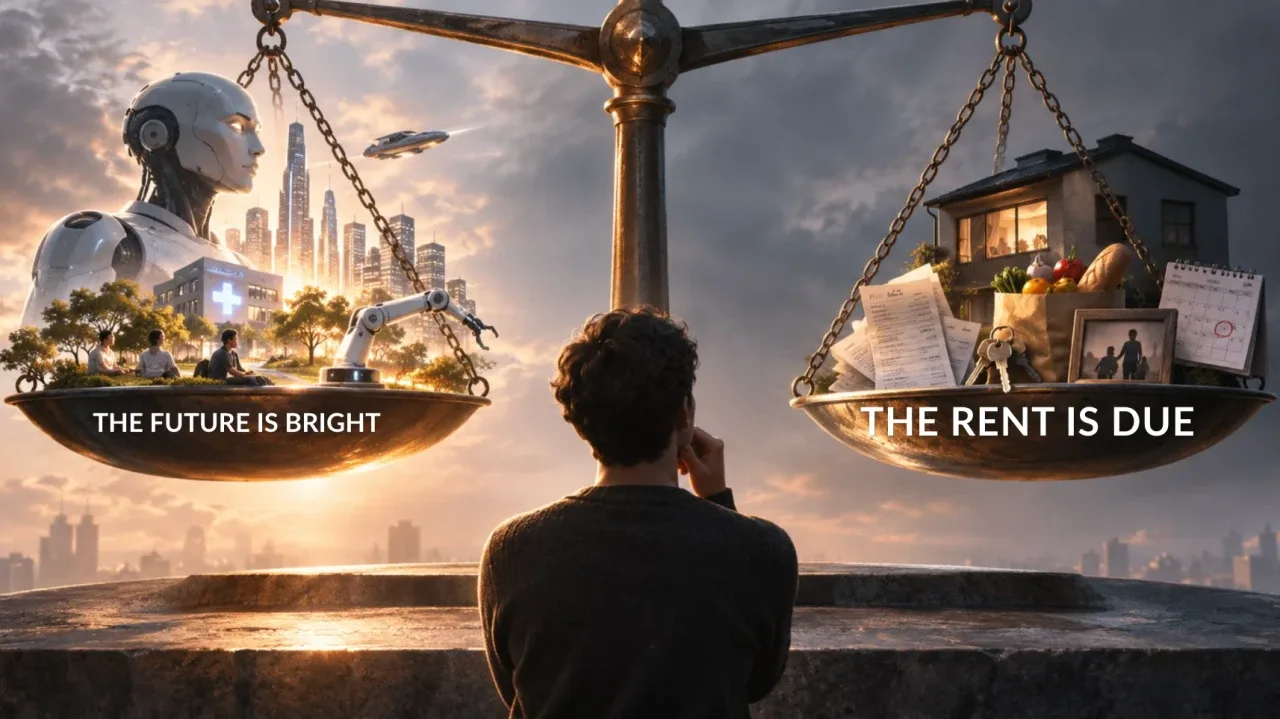
I would like to join it. If my job disappears before the income arrives, I assume the future will explain the delay to my landlord.
First, the rent
In the same interview, Musk suggested that the robots would probably be rented out.
An owner, a customer, a payment. I understood that part immediately.
Renting could give more businesses access to robots. Lower prices could benefit their customers. But neither gives a worker a guaranteed income after losing a job.
Your salary does not automatically become a dividend when your job is automated.
Imagine your employer replaces your role with AI. The company produces more with fewer employees. You receive a final paycheck and an announcement about improved efficiency.
Your rent is still due. Your family still needs groceries. No replacement income has arrived.
The company has moved into the future. Your bills remain impressively committed to the present.
New jobs, lower prices or public support might help. The question is what you live on while you wait. Anyone promising prosperity for everyone needs to explain who pays for the transition.
Please do not interrupt progress
Income is only part of the question. People also need a way to challenge decisions that affect their lives, especially when a powerful institution benefits from those decisions.
Consider the environmental lawsuit against xAI, the company behind Grok.
A sworn Pentagon declaration described Grok’s military use, including support for targeting and intelligence. It did not establish that Grok independently chose targets or authorized strikes.
In June, the U.S. Department of Justice asked a court to dismiss the lawsuit, brought by the NAACP civil rights organization. Its filing cited Grok’s military importance and warned that restrictions on its power supply or computing capacity could harm military operations.
The government wanted to end a citizen lawsuit against a company whose technology it relied on.
We welcome independent oversight. Please avoid using it on anything we have made essential.
On October 19, the court allowed the government to join the proceedings but rejected its claimed right to dismiss the citizens’ lawsuit. On October 30, it also rejected a separate request by xAI and its subsidiary to dismiss the claims. These rulings allowed the claims to proceed; they did not settle the environmental dispute.
That is what a right to object looks like when it has practical force.
Principles cost money
The uncomfortable part is how easily we can sympathize with the request to keep things moving.
We support independent oversight. Then it delays our launch, costs us a contract or reduces the value of our investments. Suddenly, we have a more sophisticated view of oversight.
The company is creating jobs. The country needs an advantage. The competition will not wait.
Those concerns can be real. They still leave a question: do the people affected retain the right to challenge us when their challenge becomes expensive?
Using a chatbot does not give a customer the same responsibility as someone deciding how to deploy it. But each of us can ask whether we demand the same standards when our own interests are at stake.
Apparently, our plan for becoming wiser is to give our current habits more computing power.
A place for the humans
I want better medicine, useful robots and more time to live. I would welcome a world where fewer people have to spend their days doing work they hate.
Being less useful to an employer should not mean having less say in your own life.
The promise of abundance needs practical commitments: a way to share the gains, support through the transition, and the right to challenge decisions even when a company loses money or a government loses an advantage.
For a worker, that means knowing how to pay the bills when the job ends. For a community, it means being able to take a powerful supplier to court. For the rest of us, it means accepting those rights when exercising them gets in our way.
Let the robots do the work. We should keep the right to be inconvenient.
Sources
Elon Musk at the Baron Investment Conference: transcript — November 6, 2026.
https://elonmuskarchive.org/video/baron-investment-conference-2026-11-06
Cameron Stanley’s sworn declaration on Grok’s military use — June 15, 2026.
https://storage.courtlistener.com/recap/gov.uscourts.msnd.52261/gov.uscourts.msnd.52261.58.1.pdf
U.S. Department of Justice motion to intervene and dismiss — June 15, 2026.
https://www.justice.gov/opa/media/1446141/dl?inline=
Court order allowing government intervention but denying dismissal — October 19, 2026.
https://caselaw.findlaw.com/court/us-dis-crt-n-d-mis-oxf-div/515787.html
Court order denying xAI’s separate motion to dismiss — October 30, 2026.
https://docs.justia.com/cases/federal/district-courts/mississippi/msndce/3%3A2026cv00074/52261/139