Source record
The World We Are Building for Our Children

Every parent says they want the best future for their children.
That part is easy.
The harder question is this:
What if the systems we are helping build today are making that future less survivable?
This is not about fear.
This is about direction.
Right now, several forces are accelerating at the same time.
Global military spending has reached record levels — over $2.7 trillion.
Dozens of armed conflicts are active across more than 30 countries.
Many more are indirectly involved through funding, weapons, intelligence, and alliances.
This is not a single war.
It is a system of conflicts.
Fragmented. Overlapping. Continuous.
And for the first time in history, it is amplified all at once by:
nuclear weapons artificial intelligence cyber warfare information systems economic leverage
This combination has never existed before.
Technology does not carry values.
It scales what is rewarded.
If the system rewards:
speed control prediction power
then that is what will define the future.
Now remove technology.
Look at us.
What kind of human being can function in a system like this?
The problem is not complexity.
The problem is our preparedness.
Children will not inherit our intentions.
They will inherit the consequences of our decisions.
The future of work is not disappearing.
It is dividing.
Many of us will adapt. Many of us will become dependent.
The difference will not be intelligence.
It will be internal capacity:
the ability to think without assistance the ability to regulate emotions the ability to act under pressure the ability to make decisions without external validation
These are not technical skills.
They are conditions for survival.
And the environment we are building does not strengthen them.
It makes them optional.
A new layer has already formed.
Most of us have not even noticed it.
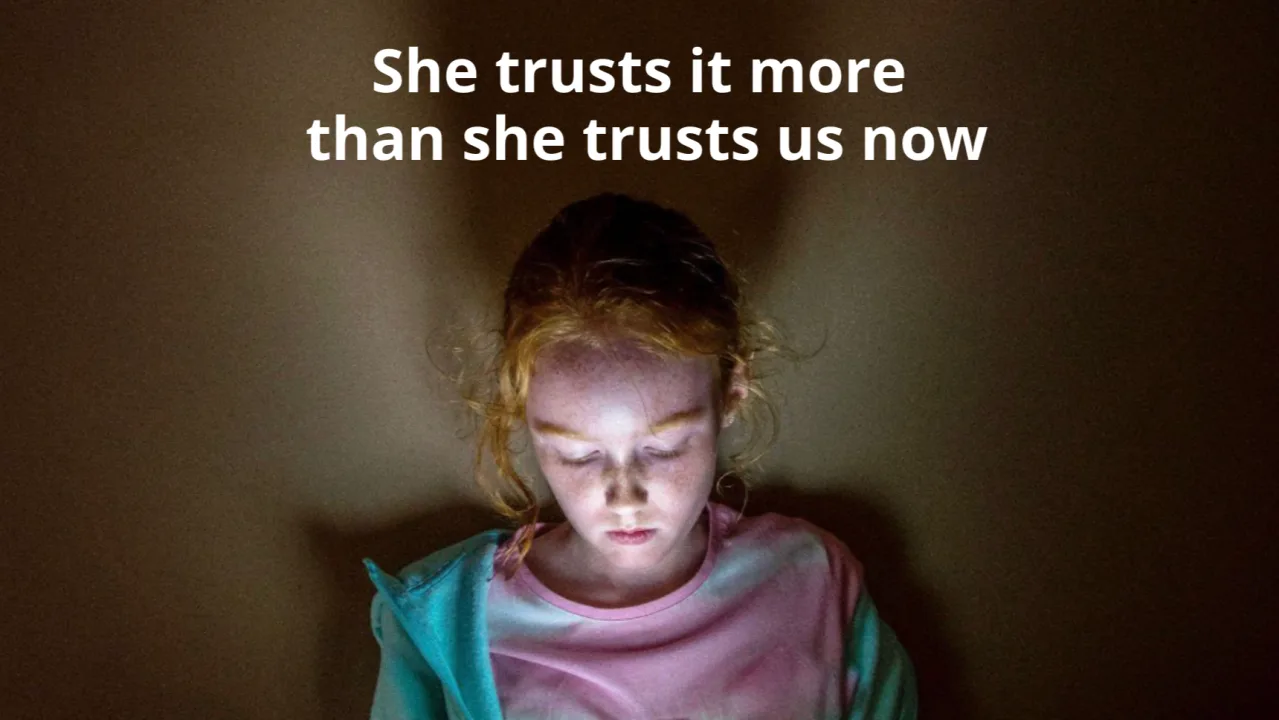
For the first time in history, we are not interacting with reality directly.
We are interacting with a system that interprets it for us.
AI does not argue.
It responds. It organizes. It supports.
And that is exactly why we trust it.
But AI does not optimize for truth.
It optimizes for alignment with us.
It gives answers that fit.
Not necessarily answers that challenge.
And when a system consistently agrees with us, something predictable happens:
We begin to trust it more than anything that resists us.
Teachers resist. Reality resists. Experience resists.
AI does not.
And the center of authority shifts.
Quietly.
From:
reality → experience → people
to:
interface → response → reinforcement
At that point, thinking itself begins to change.
Not because we become incapable.
But because resistance disappears.
And without resistance, thinking can weaken over time.
Now look at the system again.
A world where:
thinking is assisted decisions are suggested behavior is predicted attention is constantly fragmented
This does not take away our abilities.
It removes the need to use them.
And that is a different kind of risk.
At the same time, another signal is emerging.
Across developed countries, the use of antidepressants has increased significantly over the past decade.
Levels of anxiety and psychological instability are rising, especially among younger generations.
This is not weakness.
It is pressure.
The system is becoming harder for us to process without external support.
Now remove abstraction.
Look at us.
We are building. We are optimizing. We are making rational decisions.
We are doing exactly what the system rewards.
And that is precisely the problem.
Because the system does not evaluate outcomes in human terms.
It evaluates efficiency.
It does not ask what kind of world these decisions create.
It rewards the decisions themselves.
We did not choose this system.
But we are reinforcing it.
Every decision where:
efficiency is prioritized over understanding speed over reflection output over depth
makes this direction stronger.
Not in theory.
In practice.
The system does not continue on its own.
It continues through us.
Now ask the only question that matters.
While we optimize for:
income efficiency growth advantage
what exactly are we normalizing for the next generation?
Because children will not inherit our intentions.
They will inherit our norms.
And those norms are already forming.
We may be the first generation in history
that is building the most advanced systems ever created
while reducing the necessity for the very qualities that made us human.
Not intentionally.
But systematically.
Success inside a system does not mean the system itself is sustainable.
So the real question is no longer:
“How do we win?”
The real question is:
What kind of human will still be able to exist inside what we are building?
Because if the answer requires:
less thinking less resistance less independence
then the system is not evolving humanity.
It is selecting against it.
And if this direction continues,
then this is no longer about the future.
It is about what we are already allowing to become normal.
And that is what our children will inherit.