Source record
The Responsibility We Are Quietly Delegating to Machines
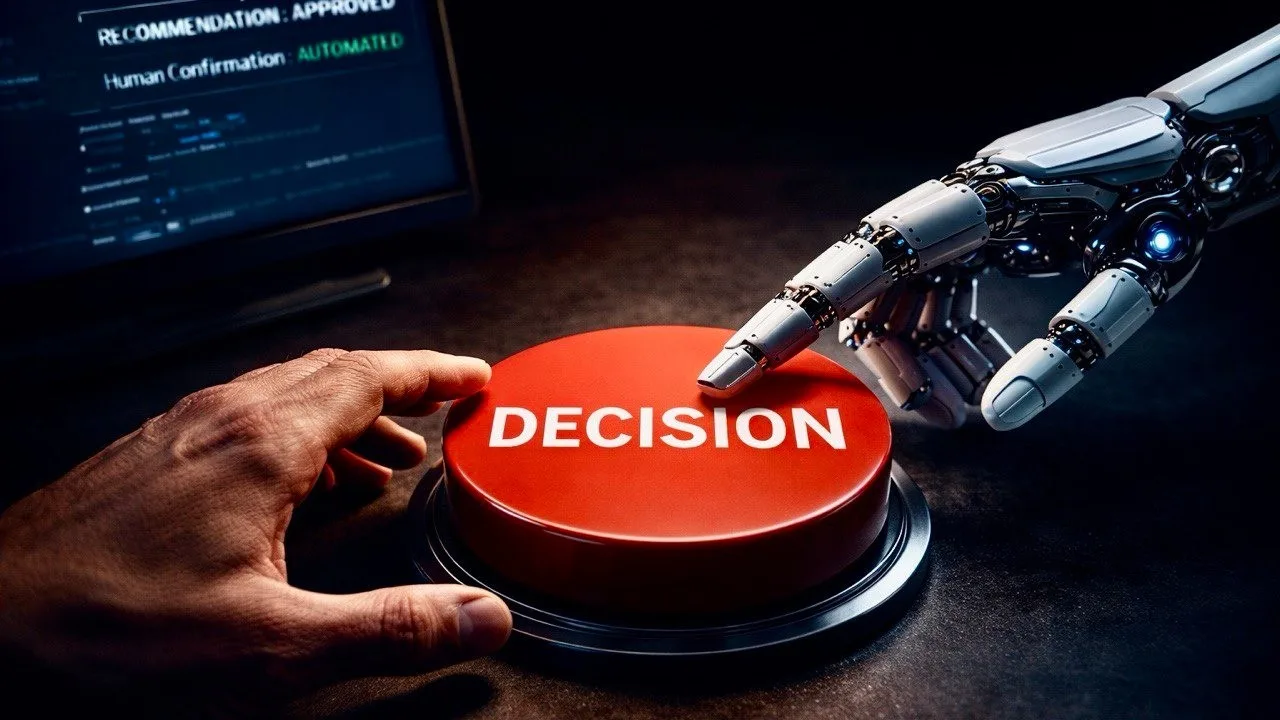
The real danger of artificial intelligence is not that machines will replace human work. It is that humans may begin to outsource responsibility.
For the past two years, most conversations about artificial intelligence have focused on productivity.
Lean teams. Automated operations. AI agents replacing routine work.
The examples are everywhere.
Small teams producing extraordinary output - something that would have required entire departments just a decade ago. Companies running with a fraction of the staff they once required. Revenue per employee rising to levels that would have sounded impossible not long ago.
In that sense, the story of AI is often told as an economic success story.
Fewer people. More output. Higher margins.
But beneath this productivity narrative, something deeper is unfolding.
A shift that has far less to do with automation, and far more to do with responsibility.
The real transformation is not that machines are beginning to do our work.
The real transformation is that humans are beginning to quietly delegate their decisions to them.
Every technological shift starts with efficiency.
A new tool appears.
At first, it helps.
AI summarizes information faster than humans. Analyzes vast datasets. Finds patterns we might overlook.
Companies use it to optimize workflows.
Reports are generated automatically. Customer interactions are automated. Marketing systems adjust campaigns in real time.
The early results look extraordinary.
Efficiency improves. Costs decline. Teams shrink.
This is the phase most discussions about AI focus on, and it is easy to see why.
The economic incentives are overwhelming.
But optimization is only the first step.
Once a system proves useful, another shift begins.
People start trusting it.
At first, humans verify the output.
An analyst checks the model. A doctor reviews the recommendation. A manager validates the data.
But over time, verification slowly fades.
Not out of negligence, but out of efficiency.
If the system works most of the time, checking every output becomes expensive.
So people check less.
Eventually the machine becomes the default source of judgment.
Not because it is perfect.
But because it is fast.
And with that shift comes a subtle psychological relief.
Decisions become easier to justify.
The model suggested it. The system recommended it. The algorithm ranked the options.
Responsibility begins to feel distributed, even when it is not.
This shift is subtle, but profound.
The machine is no longer simply assisting human decisions.
It is beginning to frame them.
The last few years have shown how fragile automated systems can become when humans begin trusting them too quickly.
Similar patterns have appeared in other industries as well.
Klarna famously replaced a large portion of its customer service workforce with AI systems capable of handling millions of interactions.
The company celebrated the efficiency gains.
Then the problems appeared.
Service quality deteriorated. Engineers were pulled from their core work to handle customer issues. The company eventually began hiring human agents again.
The lesson was simple.
Automation is easy.
Understanding where humans remain necessary is much harder.
Similar patterns have appeared in other industries.
McDonald’s removed an AI-powered drive-through system after repeated ordering errors during testing.
Deloitte Australia reimbursed part of a government contract after an AI-assisted report contained fabricated references that had not been properly verified.
The problem was not that AI made mistakes.
Humans make mistakes too.
The real issue was that people trusted the system too quickly.
These examples are not isolated failures.
They reveal a recurring pattern: systems are easy to deploy, but much harder to trust without human judgment.
In many industries, errors in automated systems are inconvenient.
A marketing algorithm wastes budget. A pricing model miscalculates demand.
The result is financial loss.
Companies absorb the cost, fix the model, and move on.
But some systems operate in environments where the cost of error is measured differently.
In those environments, the price of a mistake is not money.
It is human life.
Healthcare is one of the most promising areas for artificial intelligence.
AI can analyze medical images faster than specialists. Detect patterns across millions of records. Support doctors in diagnosis and treatment planning.
Used carefully, these tools can improve care.
But healthcare also reveals the limits of delegation.
When AI becomes integrated into clinical workflows, it does more than provide information.
It begins to shape medical judgment.
A model highlights certain diagnoses as more probable. Recommends a specific treatment path. Flags one patient as higher priority than another.
The system does not replace the physician.
But it quietly shapes the decision.
And when that frame is wrong, the consequences are not abstract.
They affect real patients, in real hospitals, in real time.
That is why healthcare leaders increasingly emphasize something that sounds deceptively simple:
Human oversight cannot disappear.
Not because machines are useless.
But because responsibility cannot be automated.
The risks become even clearer in military systems.
Modern warfare is increasingly shaped by automated analysis.
Algorithms process surveillance data. Prioritize targets. Evaluate probabilities.
These systems do not replace human operators.
They accelerate them.
Decisions that once required hours now take minutes.
Sometimes seconds.
The human is still present.
But the tempo of the system changes the nature of their role.
Instead of deliberating over a decision, the operator confirms it.
The machine proposes. The human approves.
And when conflict unfolds at machine speed, that approval can become little more than a procedural step.
History offers a striking example of why that matters.
In 1983, a Soviet early-warning system detected what appeared to be incoming nuclear missiles from the United States.
The system classified the signal as a real attack.
Protocol required the officer on duty to report the launch immediately - a step that could have triggered a nuclear response.
The officer on duty was Stanislav Petrov.
Looking at the data, the system showed five incoming missiles.
But Petrov hesitated.
His reasoning was simple.
If the United States had started a nuclear war, it would not launch five missiles. It would launch hundreds.
He reported the alert as a false alarm.
Later it turned out he was right.
The system had misinterpreted sunlight reflections on clouds as missile launches.
The lesson was not that the system was malicious.
The lesson was that automated systems can look extremely convincing, even when they are wrong.
And sometimes the only barrier between a system error and a global disaster
is a human willing to question the machine.
There is also a deeper psychological dimension to this transformation.
Responsibility is heavy.
Strategic decisions carry risk. Medical choices affect lives. Military actions shape the fate of nations.
For centuries, those burdens rested entirely on human judgment.
Artificial intelligence introduces something new.
A subtle psychological escape.
When a decision emerges from a complex algorithm, responsibility becomes easier to diffuse.
The model suggested the action. The system calculated the probability. The algorithm ranked the options.
The human merely confirmed the result.
The psychologist Eric Berne once described how people construct “games” that allow them to avoid direct responsibility for difficult choices.
In those games, people often believe they are in control of the situation, until the structure of the game itself begins shaping their behavior.
At that point, the game is no longer something they play.
It becomes something that plays them.
Technology did not invent this behavior.
But intelligent systems can amplify it dramatically.
When decisions increasingly come from algorithms, people may begin to experience something dangerously comfortable:
the feeling that responsibility belongs to the system, not to them.
For centuries, human intelligence was the central bottleneck in every complex system.
Organizations were limited by how much information people could process. How quickly they could analyze. How accurately they could predict.
Artificial intelligence removes that constraint.
Information processing is no longer scarce. Pattern recognition is no longer scarce. Strategic analysis is no longer scarce.
For the first time in history,
intelligence itself is becoming abundant.
But abundance creates a new bottleneck.
Responsibility.
In the coming years, AI will continue to transform organizations.
Teams will become smaller. Systems will become faster. Automation will expand into areas that once seemed entirely human.
But one role will remain fundamentally human.
Someone will still have to decide:
What the system should optimize. What risks are acceptable. Where the boundaries lie.
The real challenge of the AI age is not preserving human work.
It is preserving human responsibility.
Because systems can optimize decisions.
But only humans can remain accountable for them.
When intelligence becomes abundant, responsibility becomes the scarcest resource in human systems.
And the hardest thing for humans to resist
is the temptation to delegate it.