Source record
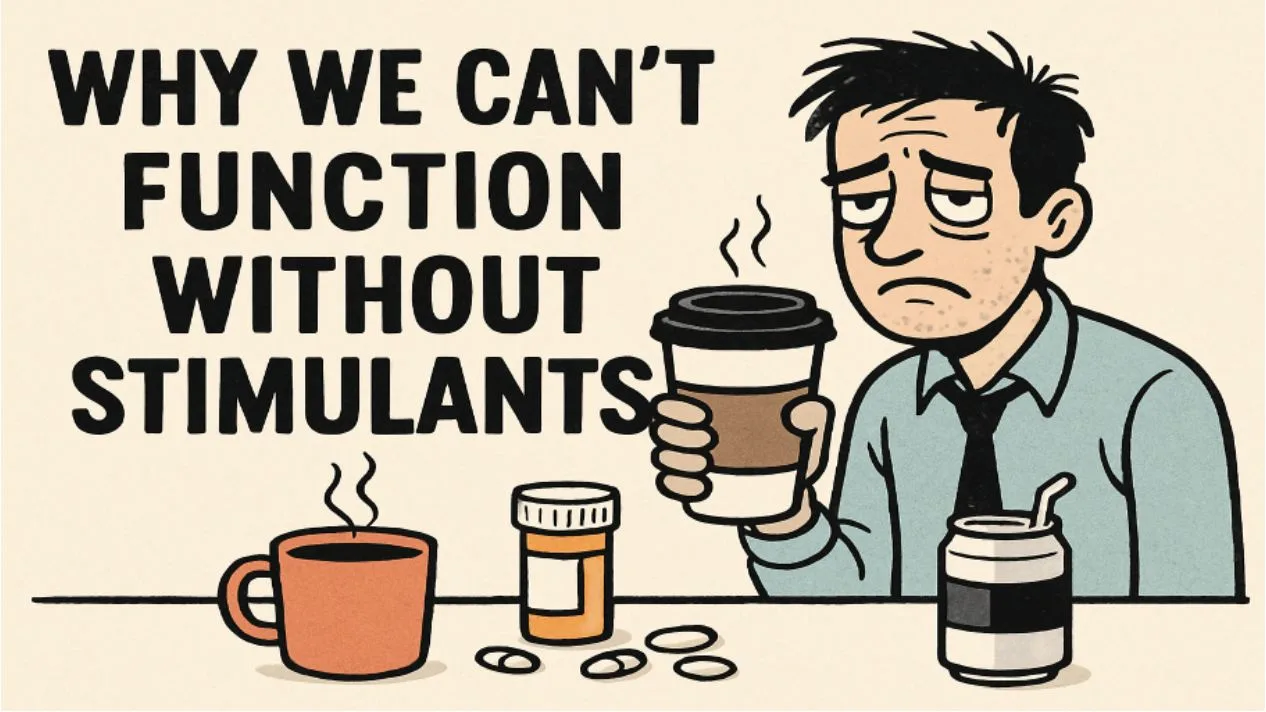
Why We Can’t Function Without Stimulants
It's 6:00 AM. Your alarm bleats in the darkness. Before you’re even fully awake, your hand fumbles for the phone – a quick hit of news alerts and overnight messages to jolt your brain into gear. Next, you shuffle to the kitchen for that essential first cup of coffee. You insist you can’t function without it – and you’re not alone.
Take away the coffee, the morning social media scroll, the nicotine fix, the sweet snack for energy, the ping of new emails, the late-night Netflix... What’s left of “you” without these daily crutches? Could you get through a single day un-stimulated? A week? An entire life? In a culture where everyone is hooked on something, the question hardly even comes up.
Our daily lives are propped up by a veritable survival kit of stimulants and distractions. Consider a typical day in modern life and its menu of mandatory pick-me-ups:
Caffeine: Coffee, tea, energy drinks – the legal addictive stimulants we guzzle to kick-start the morning or combat the afternoon slump. Digital Hits: The endless buffet of content – doomscrolling news, swiping on dating apps, diving down YouTube rabbit holes, scrolling TikTok – keeping our dopamine receptors pinging from dawn till dusk. Nicotine & Other Boosts: That cigarette or vape break “to focus,” or maybe a quick puff just to calm the jitters (ironically using a stimulant to feel calm). Sugar and Snacks: Reaching for a donut, candy bar, or sugary “energy” bar whenever boredom or fatigue strikes, riding brief highs followed by crashes. Pills & Supplements: A multivitamin and two mood stabilizers before breakfast, perhaps? Antidepressants to stay afloat, maybe an anti-anxiety or ADHD med, plus a handful of supplements promising sharper focus, better sleep, or just something to fill the void.
Individually, each item seems trivial, even helpful. Culturally, we’ve normalized this cocktail as not just acceptable but necessary.
Your coworker jokes she’s “useless until I’ve had my coffee” while wearing a t-shirt that says But first, coffee. The guy next to you scrolling through his fourth hour of TikTok isn’t seen as an addict; he’s just passing time. Taken together, though, these habits form a personal dependency toolkit. We don’t call it addiction – we call it getting through the day.
We like to believe we need these stimulants to function – but do we, really? There’s a fine line between genuine need and habitual dependence. Sure, if you skip your usual caffeine dose, you’ll likely get a headache and feel like a zombie; but that’s not true innate fatigue – it’s withdrawal from an artificial high. We’ve trained our bodies and minds to expect constant boosts and novelties at the slightest hint of discomfort. Feeling a bit down or restless? Better refresh your feeds, pop a piece of chocolate, or find some other external spark to smooth the mood.
The uncomfortable truth is that much of what we label as necessity is actually emotional dependency. Coffee doesn’t truly replace sleep; it just tricks your nervous system for a while. Scrolling Instagram when you’re lonely doesn’t give you real connection; it just blunts the ache for a moment with a flurry of images and likes.
Yet we’ve built routines and even identities around these crutches. They keep us functional in the sense that we can avoid facing underlying fatigue, boredom, sadness, or anxiety – at least for now. The cracks begin to show if the Wi-Fi goes out, or the coffee machine breaks, or we run out of cigarettes. Suddenly, the “necessities” reveal themselves as the dependencies they truly are.
Look around and it’s obvious: we live in an age of constant stimulation. Silence and stillness have become endangered species. The modern world gives us unlimited ways to never be alone with our thoughts – and we eagerly embrace them. It’s not just you or me; it’s a collective addiction. We bond over it.
Offices run on coffee and office gossip. Friendships subsist on shared screens and memes. The entire economy of social media and entertainment is built on the premise that we cannot tolerate a moment of unengaged time. And it’s working – the average person reflexively checks their phone dozens, even hundreds, of times a day, seeking the next hit of information or excitement.
This cultural dependency runs so deep that anyone not constantly stimulated feels like the odd one out. If you decline the after-dinner TikTok binge or choose to sit quietly without scrolling, people might ask if something’s wrong. Being “bored” is nearly a sin; we treat downtime as unproductive or wasteful.
We celebrate the go-getter who lives on caffeine and enthusiasm, and we wink at the coworker who jokes about needing wine or Xanax to unwind from the day’s manufactured stress. From trending supplement fads to the latest binge-worthy series everyone is glued to, there’s always a new stimulant to chase. We have, collectively, normalized a baseline state of distraction and called it living.
Strip away all the hits, highs, and distractions – what remains? It’s a terrifying thought for many. Underneath the caffeine, the constant music and podcasts, the comforting pings of online life, we’re left with something we hardly recognize: ourselves. Raw existence, with no filter and no anesthetic. No wonder we avoid it.
In one eye-opening study, people were asked to sit alone in a quiet room with nothing to do for just 15 minutes. Many of them became so uncomfortable that they chose to administer mild electric shocks to themselves rather than endure their own thoughts in silence. Pain was preferable to boredom.
What are we so afraid of finding in the quiet? Perhaps it’s the fatigue we’ve been postponing for years, or the grief and anxiety caffeine and Instagram have helped us paper over. Maybe it’s the unsettling question of what our life is really about, once the noise dies down. When the stimulants fade, we might realize how exhausted we truly are, how unmoored our minds have become without a constant feed to latch onto. Without our stimulation IV drip, we might actually have to feel something real – and that prospect scares us to death.
No, you don’t have to quit coffee forever or throw your smartphone into the ocean. But what if we titrate down our dependence and taste a bit of stillness? Think of it as an experiment in sanity. Try a morning without immediately reaching for your phone – let the brain fog linger and see if it clears on its own. Take a walk at lunch with no headphones, just you and the ambient hum of the world.
In the evening, resist the autopilot urge to drown your thoughts in TikToks or trivial content; instead, sit with that discomfort for a few minutes. Yes, it will feel strange – possibly dull, maybe even uncomfortable as hell. But it won’t kill you – in fact, that restlessness is your mind slowly coming off the high of constant input.
In the stillness, if you stick with it, something interesting might happen. You might catch a glimpse of clarity between the anxious thoughts. You might notice a feeling that’s been hiding under all the noise, begging to be acknowledged. You might, for a brief moment, remember what it’s like to simply be, without needing to do or consume or fix anything. That quiet place is where real life happens – the kind that isn’t dependent on an external stimulant or screen.
Ultimately, the question isn’t really “Could you survive without stimulants?” but “Could you start living without them?” We’ve seen what half-alive, constantly doped-up existence looks like: jittery, frantic, and numb all at once. Perhaps a life with a little less artificial buzz could be more awake in the truest sense. The next time you reach for one of your many survival kit items, pause for a moment. Ask yourself: Do I actually need this right now, or am I just afraid of what I’d feel without it? That tiny moment of honesty – that sliver of stillness – might be the bravest thing you do all day.