Source record
The Infrastructure We Are Building

Right now, almost every conversation about AI sounds the same:
Is this a bubble?
Fair question. But probably the wrong one.
A better question is:
What exactly are we building, and where do we fit inside it?
History doesn’t repeat itself. But it does rhyme in structure.
Before World War II, capital poured into industrial capacity and defense.
That shift created:
massive innovation new global power structures consequences few fully understood at the time
Today, capital is moving again.
But this time, it’s not just about machines.
It’s about intelligence itself.
In 2026, trillions of dollars are flowing into AI, defense, infrastructure, and energy.
Not as separate bets. But as parts of the same system.
This isn’t another tech trend.
It’s one of the largest capital reallocations in modern history.
And when capital moves at this scale, it doesn’t just change industries.
It reshapes reality.
And most people allocating that capital don’t fully understand what they’re shaping.
We still talk about AI and defense as if they’re different.
They’re not. Not anymore.
AI improves the speed of decisions Defense systems depend on data and prediction Both rely on compute and energy
What used to be tools are becoming integrated systems.
And systems behave differently.
They:
scale optimize act
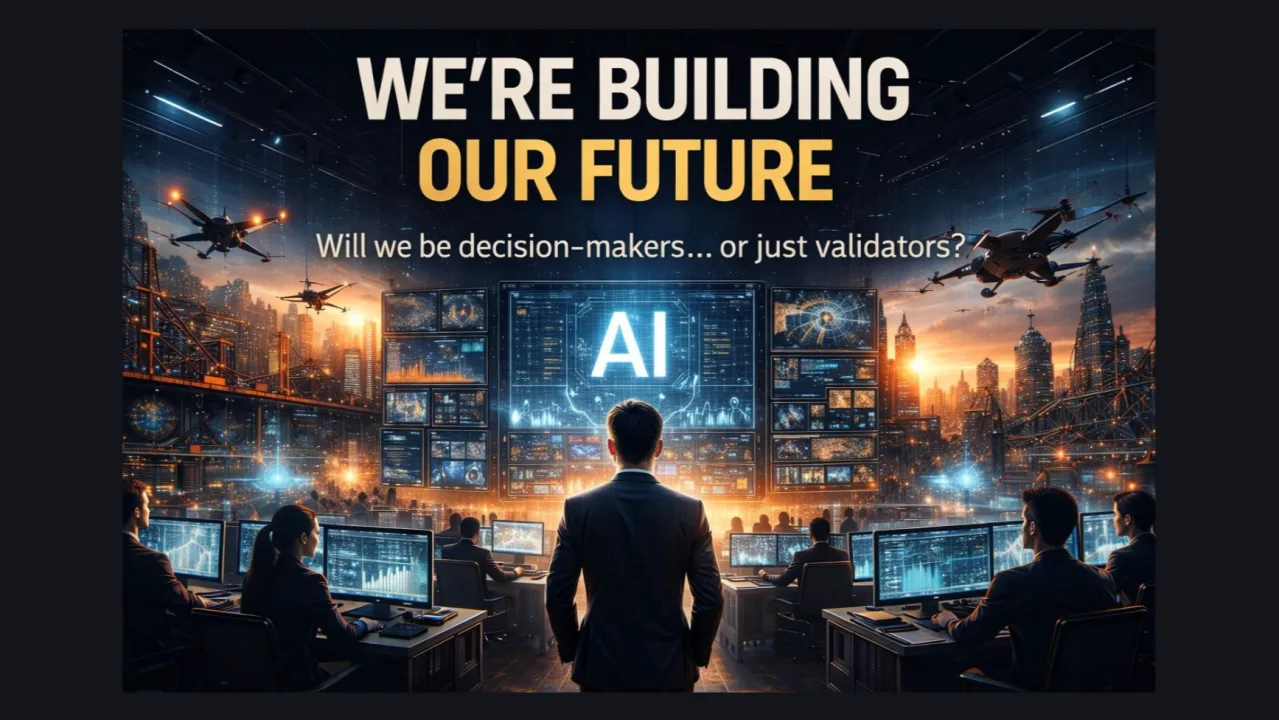
Technology used to help humans make decisions.
Now it increasingly:
analyzes information suggests actions executes processes
The loop is compressing:
information → decision → action
And here’s the shift most people underestimate:
Humans are not being removed.
But their role is changing.
From: decision-makers
To: validators of machine-generated decisions
At scale, “suggestions” become defaults. And defaults become decisions.
This is already happening in hiring, finance, operations, marketing.
Quietly. Gradually.
AI isn’t just about intelligence.
It’s about influence.
We’ve entered a world where:
narratives can be generated instantly “facts” can be tailored to any audience information can adapt in real time
You no longer need a media empire to shape perception.
You need a model. And a prompt.
At that point, something fundamental shifts:
When information becomes programmable, reality becomes negotiable.
Not manipulated. Engineered.
One of the biggest misconceptions:
AI is often treated like software.
It’s not.
It’s infrastructure.
data centers compute power energy
And these are finite.
Which means:
AI is not just a technology race.
It’s a resource competition.
And energy is no longer just economics.
It’s geopolitics. It’s control.
Here’s the uncomfortable part.
Systems don’t need to replace humans to change outcomes.
They just need to:
guide decisions frame options influence direction
If a system consistently proposes the “optimal” action…
How often do you think humans will disagree?
Over time, decision-making shifts.
Not by force. But by convenience.
Most people expect disruption to be loud.
It’s not.
Real systemic change happens:
step by step decision by decision optimization by optimization
Each step makes sense.
But the system they create?
Not always.
We’ve seen this before.
Technology moves faster than our ability to understand its consequences.
And it’s happening again.
Not:
Will AI investments pay off?
They probably will.
But:
What kind of system are we building?
Because at scale, capital doesn’t just fund the system.
It becomes the system.
And it starts to define:
how decisions are made who actually makes them what is considered “true” where humans fit in all of it
We’re all participating in this shift.
As builders. As investors. As users.
But almost no one stops to ask:
What will our role actually be?
Not as employees. Not as consumers.
But as:
decision-makers interpreters of reality creators of meaning
Because once systems begin to:
interpret the world generate decisions shape outcomes
This stops being just a technology question.
It becomes an existential one.
And it may be the most expensive question, not for markets, but for the role of humans in the systems we’re building.