Source record
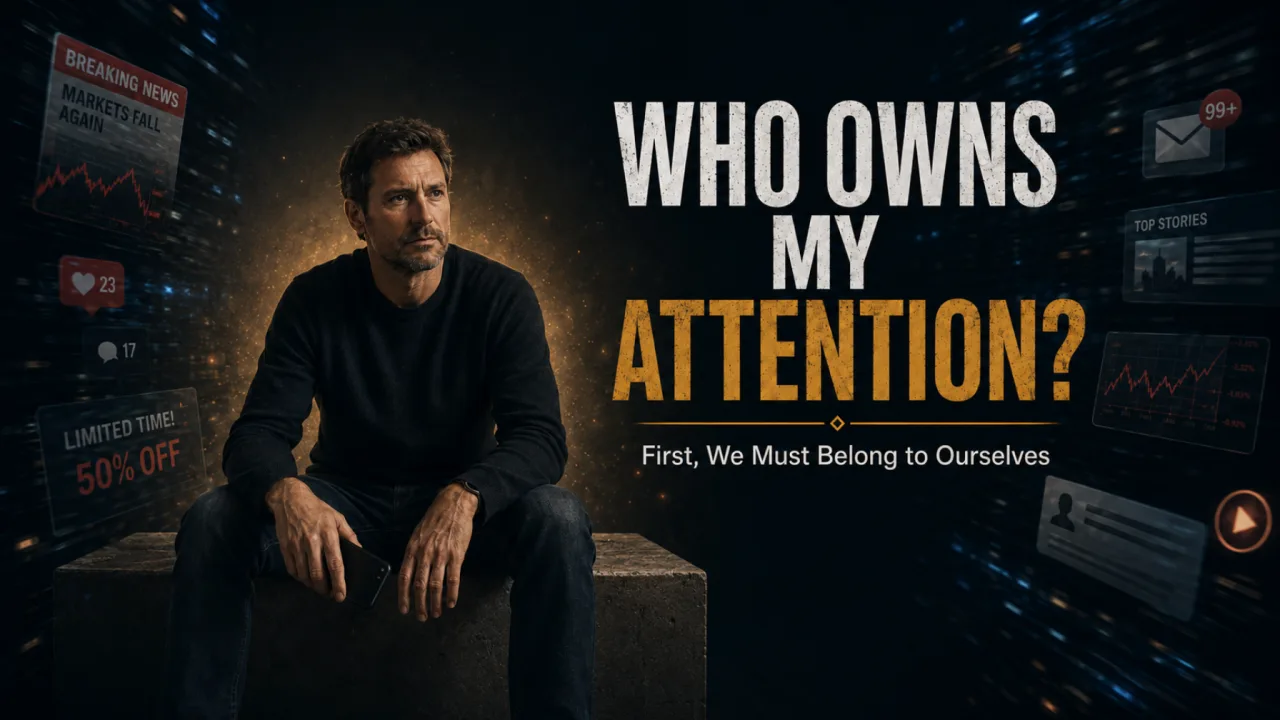
First, We Must Belong to Ourselves
The world is no longer just fighting for our attention.
It is fighting for the right to influence our state of mind, our decisions, and our behavior.
News creates anxiety. Social media holds our attention. Algorithms show us what we are most likely to react to. Advertising turns our weak spots into desires. Artificial intelligence is accelerating the flow of information so quickly that it is becoming harder to stay calm, clear, and independent.
For a long time, we believed that intelligence was the main human advantage.
To think faster. To know more. To analyze better. To find answers more quickly.
But in the age of AI, that logic is changing.
What used to take a person hours can now be done by a machine in minutes. AI can write, calculate, search, compare, structure ideas, summarize information, and generate plans at a speed no human can realistically match.
That does not mean human thinking has lost value.
It means speed of thinking is no longer enough.
The real question is no longer only how fast we can get an answer.
The real question is:
Which answer can we trust? Which information should we accept? Which decision is truly ours? And where are we actually thinking — instead of automatically reacting to an outside signal?
Speed without inner control does not make us stronger.
It simply moves us faster in a direction we may never have consciously chosen.
A fast person without critical thinking makes mistakes faster. A fast person without emotional stability reacts faster to pressure. A fast person without a goal moves faster in the wrong direction. A fast person without self-discipline loses inner ground faster.
AI can make our work faster.
But AI cannot replace maturity.
It can give us more information. But it cannot give us clarity. It can offer us options. But it cannot take responsibility for our choices.
That is the real shift.
In the age of artificial intelligence, the most important human skill is not speed of thinking. It is the ability to stay in control of our attention, emotions, decisions, and direction.
The main question of our time is not only:
How fast do you think?
The deeper question is:
Who is controlling your thinking in that moment?
Is it you? Your fear? Your fatigue? Someone else’s opinion? An algorithm? Or the endless flow of information that has simply carried you away?
We live in an environment that is constantly trying to manage us.
If we do not learn to manage ourselves, external systems will manage us instead.
This is not abstract philosophy. This is everyday life.
We wake up and immediately reach for our phones. We react to other people’s opinions. We consume an endless stream of content. We postpone important decisions. We get irritated. We lose focus. And often, we do not even notice that the day did not happen by our choice, but by someone else’s script.
Self-discipline is often misunderstood.
It is not a military regime. It is not the absence of joy. It is not about suppressing yourself.
Self-discipline is the ability not to betray your direction every time life becomes difficult.
Self-control is not the absence of emotions.
It is the ability not to give your emotions the right to make decisions for you.
Emotional stability is not coldness.
It is the ability to remain human under pressure.
Critical thinking is not the habit of doubting everything.
It is the ability to pause and ask:
Is this true? Is this important? Is this really my decision? Or am I being driven by fear, fatigue, resentment, an algorithm, or someone else’s opinion?
Mental flexibility is not weakness.
It is the ability to admit a mistake, change the approach, listen to new information, and still not lose the main direction.
This is becoming one of the most important skills of our time.
Because there is more information. More pressure. More uncertainty. More options.
But more options do not always mean more freedom.
Sometimes they simply mean more chaos.
And in that chaos, the winner is not the person who reacts the fastest.
The winner is the person who can stop, think, withstand pressure, and make their own decision.
I feel this very clearly through the experience of Beeezo.
From the outside, a startup often looks beautiful: an idea, energy, big plans, presentations, partnerships, movement forward.
But inside, the reality is very different.
Pressure. Uncertainty. Mistakes. Waiting for results. Limited resources. Difficult conversations. Decisions that cannot be passed to someone else.
There were periods when it would have been easier to stop.
To say that the path was too hard. That the market was not ready yet. That the circumstances were too difficult. That we could choose a calmer life.
But those are exactly the moments when we are tested not only as a business.
We are tested as people.
In those moments, the problem is not only strategy.
The problem is whether we can avoid making decisions from fatigue, fear, irritation, or the desire to release pressure as quickly as possible.
The team is tested. Our belief in the chosen direction is tested. Our ability to keep moving forward without quick proof of success is tested.
For me, Beeezo is not only a startup.
It is a real-life experience of how an idea tests people for maturity.
We are building Beeezo around the value of real human attention and real human action. But over time, I understand more and more:
We cannot speak about the value of attention if we do not own our own attention.
We cannot speak about freedom of choice if our decisions are made from fear, fatigue, or external pressure.
We cannot build the future on technology if, inside, we are becoming weaker, more distracted, and more dependent.
That is why discipline is not a trendy habit.
Discipline is inner infrastructure.
Just as companies need processes, strategy, and a system for making decisions, human beings need their own system for returning to clarity.
For some, it is sport. For some, journaling. For some, meditation. For some, prayer. For some, silence in the morning. For some, regular planning. For some, an honest conversation with themselves.
The form is not the most important thing.
What matters is that we have a way to return to ourselves.
Because once the day begins, the outside world almost immediately enters our life: family, work, messages, meetings, problems, urgent questions, and other people’s expectations.
And if we have not created inner ground in advance, we simply start reacting.
But reaction is not control.
AI will become stronger.
Algorithms will understand our weaknesses more precisely. There will be more content, more speed, more pressure, and more attempts to influence our attention and behavior.
That is exactly why we do not need to become only faster.
We need to become clearer.
Not louder, but deeper. Not more reactive, but more stable. Not harder, but more mature.
If our attention has become a valuable resource, then the ability to manage it is a way not to give our life away to other people’s algorithms, fears, and habits.
In a world where machines think faster, our main task is not to outrun the machine.
Our main task is not to lose ourselves.
First, we must belong to ourselves.
Only then can technology become an extension of the human being — not a replacement for our will, attention, and decisions.