Source record
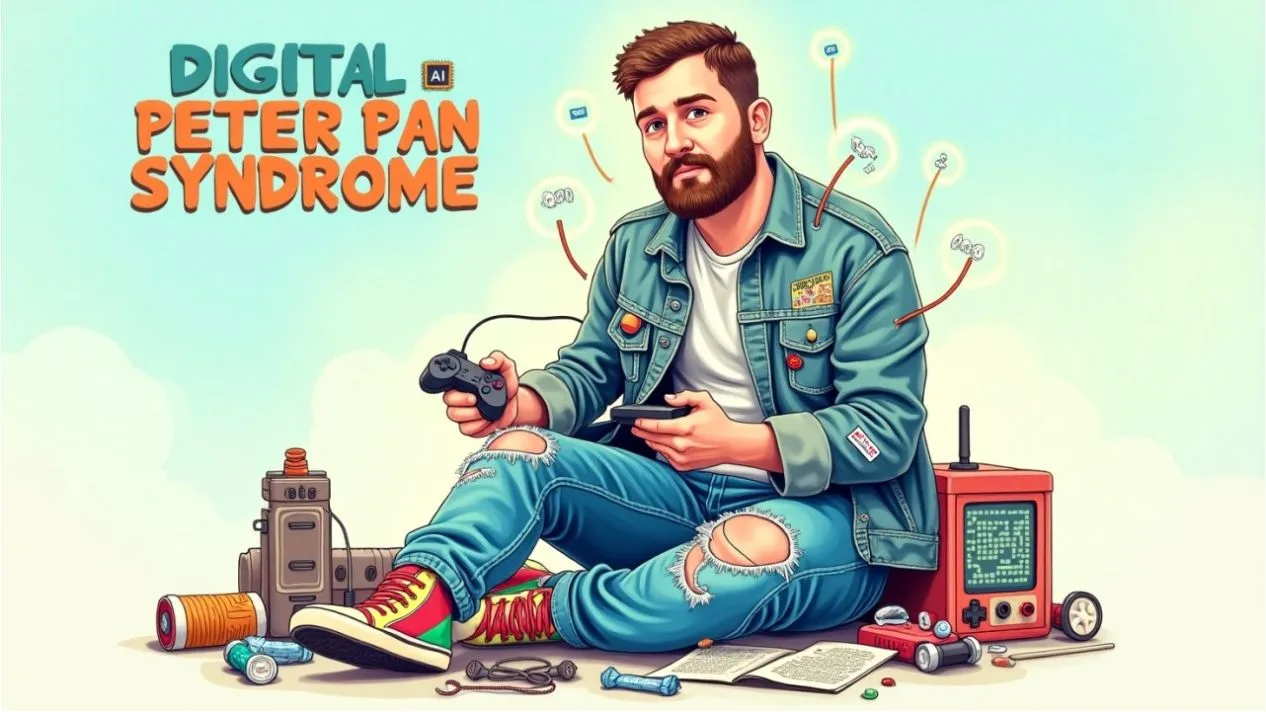
The Digital Peter Pan Syndrome: Why AI Is Making Adults Childish
In a world of algorithmic comfort and transhumanist dreams, many of us drift through adulthood swaddled in digital ease. We have more technology and “superpowers” at our fingertips than any generation before – as Elon Musk quips, your smartphone lets you “answer any question… send messages to millions… do incredible things” – yet somehow, growing up has never been so hard. Today’s 30-year-olds often feel like overgrown teenagers, deferring the milestones and responsibilities that once signaled maturity. Is our AI-assisted, app-driven lifestyle infantilizing us? This provocative question may make you squirm – and it should. Let’s pull back the curtain on our cozy high-tech nursery and take a hard look at the data, the gadgets, and our own behaviors.
If you sense that adulthood starts later than it used to, you’re not imagining it. More young adults are living with their parents than at any time since 1940. In 2014, for the first time in over 130 years, Americans aged 18–34 were more likely to live in Mom and Dad’s house than to live with a spouse or partner of their own. Across Europe, the pattern is similar: the average young European doesn’t leave the parental home until 26 years old, with some countries averaging over 30. Contrast this with mid-20th century norms – in 1960, only 24% of U.S. young adults lived at home, and the average marriage age was 21 or 22. By 2013, the marriage rate for young women had plummeted (62% were married in 1940 vs. just 13% in 2013) and first marriage age had climbed to 27. Today’s 28-year-old is often still “finding themselves,” financially and emotionally reliant on parents or institutions well into what used to be considered adulthood.
Psychologists are noticing, too. Jean Twenge, in her book iGen, documents a creeping delay in adult milestones among the generation raised on the internet. “Adolescence…now happens later. Thirteen-year-olds – and even 18-year-olds – are less likely to act like adults… Adolescence is now an extension of childhood rather than the beginning of adulthood.”. Twenge points out that 18-year-olds today look like 14-year-olds of decades past – not physically, but in terms of independence and behavior. They drive later, work later, marry later, and depend on parents longer. This is not just a youth problem; it reflects how our entire society has embraced prolonged adolescence. And while economic pressures (student debt, housing costs) certainly contribute, there’s another, more insidious force at play: technology is enabling and encouraging us to remain psychological children.
Why struggle or suffer a moment of discomfort when an app can handle it for you? Modern technology functions like a never-tiring nanny, anticipating our needs and smoothing over frustrations before we even experience them. Think about it: Our phones and AI assistants do everything but burp us. We ask Alexa for the weather instead of peeking outside. We let Google Maps shepherd us turn-by-turn so we never risk the grown-up skill of navigating a city. We swipe on Tinder to avoid the vulnerability of walking up to someone in a bar. We delegate memory to Wikipedia and decision-making to recommendation algorithms. In theory, this is the transhumanist ideal – AI augmentation of human ability. In practice, it’s feeling a lot like digital babying.
Technologist and venture capitalist Reid Hoffman envisions a future where “everyone’s going to have their own personal intelligent assistant… a companion as they navigate life,” even asking AI “I had this odd conversation with a friend… I feel a little angry and disappointed – am I right about that?”. In other words, tomorrow’s adults might offload even emotional self-regulation to a friendly AI voice. Hoffman sees empowerment, but some ethicists hear alarm bells. As one critic responded, “Always turning to another when we must decide is infantilizing”. If we let an algorithm validate our feelings and choices at every step, we risk becoming “less mature, less confident, less interested in autonomy”. The parental role that family, experience, and our own conscience used to play is being supplanted by AI tools that coddle us with instant answers and guidance. We are, in effect, outsourcing adulthood.
Dating and Relationships: Apps like Tinder or Bumble turn finding a partner into a game of swipes. Rejection stings less when it’s just another left-swipe, and awkward first moves can be skipped entirely. But this convenience means fewer young adults develop the courage and communication skills that come from wooing someone in person (or handling real-world rejection). Some even use AI to ghostwrite their flirtatious banter or breakup texts, avoiding emotional effort. (One woman recalls realizing her ex’s unusually polished goodbye message was likely composed by ChatGPT – a poignant example of algorithmic chivalry masking human cowardice.)
Instant Gratification Entertainment: Boredom used to spur creativity or push us to socialize; now we have TikTok and endless feeds for that quick dopamine hit. Why read a challenging book when you can watch 30-second videos perfectly tailored to your tastes? The result: shrinking attention spans. Short-form content “gets straight to the point” and suits our brief focus, but over time it “exacerbates our collective inability to concentrate… a vicious cycle”. Many of us, conditioned by algorithmic rewards, struggle to sit through a movie or a long article without itching for that next scroll – the hallmark of a toddler mind, not a mature one.
Navigation and Problem-Solving: Getting lost or figuring things out on the fly can be frustrating, but it teaches resilience. Now, with GPS apps, food delivery, and on-demand services, an adult in 2025 can theoretically go years without ever planning a route, cooking a meal, or confronting a minor challenge unaided. We have become helplessly competent – capable of doing so much with a tap, yet incapable of basic self-sufficiency when the tech crutch is kicked away. (Ever seen the panic when a smartphone dies and a person can’t recall anyone’s number or navigate their own city? It’s real.)
Knowledge and Memory: The entire library of human knowledge now sits in our pocket – amazing, right? It is, but there’s a downside. Psychologists talk about “cognitive offloading,” where we let our devices remember and decide for us. Over time, skills like mental math, wayfinding, or fact recall have atrophied for many. In one Stanford study, heavy multimedia multitaskers – the kind of people who constantly bounce between apps, messages, and videos – actually performed worse on cognitive tasks. “They’re suckers for irrelevancy… Everything distracts them,” observed Stanford’s Clifford Nass. The brain, like a muscle, weakens when it’s not exercised. If AI is always there to do the heavy lifting, our mental fortitude can turn flabby.
Perhaps the most unsettling form of digital infantilization is what one ethicist calls “emotional outsourcing” – handing off the hard work of feeling and relating to others. Crafting a heartfelt apology, offering condolences, expressing love or sympathy face-to-face… these are emotionally laborious tasks that truly adult adults have always had to do. Now, increasingly, we see people letting algorithms do it for them.
A striking case made headlines when a university administration issued a consoling letter to students after a tragic event – only to later apologize when it was revealed the letter was generated by ChatGPT. The content was appropriate, even caring in tone, but knowing it was machine-made felt “insincere” to recipients. Why? Because we expect human empathy behind human words. As the analysis noted, the problem wasn’t the grammar or tone – it was that “the author is not bound up in the relationship for which the words are written.” In simpler terms, it’s not the lack of a human writer, it’s the lack of human investment. Using AI to perform our emotional duties is like hiring a stunt double for our inner life.
In personal relationships, too, this temptation lurks. It’s now easy to have ChatGPT spit out a flowery apology to your spouse or a pep talk to a friend. But if you didn’t struggle through the feelings and choose the words yourself, have you actually grown from the conflict? What do we lose when we always take the easy way out of emotional labor? The answer: we lose maturity. We stunt our empathy and accountability. We remain children who never learned to clean up our own emotional mess, because a shiny machine does it for us.
Real-life examples abound. Therapists report younger clients sometimes show up with printouts of what “an AI therapist” advised them. Thousands of people have turned to chatbot “friends” for late-night venting. On one hand, accessibility to some form of support is good. On the other hand, an AI yes-man that never challenges you may just validate your feelings and tell you what you want to hear – more comfort, no growth. One 27-year-old who tried using ChatGPT as a grief counselor found it gave sensible advice, but “its words are flowery, yet empty”, missing the genuine human connection she needed. Therapy apps and self-help chatbots are booming – a reflection of both our mental health crisis and our desire for quick, on-demand solace. In 2023, over half of Millennials and Gen Z reported having gone to therapy, and nearly 40% plan to start therapy in 2024. It’s encouraging that younger generations seek help, but it also signals that many feel unable to cope alone. One can’t help but wonder: Are we all becoming a bit emotionally high-maintenance, needing constant guided support the way a child needs a parent’s reassurance?
Transhumanist thinkers have long promised that merging with technology would make us more than human – smarter, stronger, more efficient. In many ways, that promise is coming true: we truly are augmented by our devices and algorithms, enjoying conveniences and knowledge beyond our grandparents’ wildest dreams. But there’s a dark flip side: if we rely on technology for everything, we risk becoming less than the fully developed humans we could be. It’s the paradox of our age: the more powerful our tech, the more powerless we seem to become in the face of basic challenges.
The signs of this “Peter Pan syndrome” are everywhere. Universities report incoming students struggle with basic life skills and resilience. Employers find young hires need more hand-holding and feedback to function. Social observers note how pop culture now celebrates the “kidult” – adults obsessing over youth nostalgia and eschewing traditional responsibilities. None of these trends can be blamed solely on AI or apps, of course. But they flourish in a culture where discomfort is avoided at all costs and friction is engineered out of life. When every hunger pang can be satiated with UberEats in minutes, patience and cooking know-how whither. When any disagreement can be escaped by blocking someone online, conflict resolution skills don’t develop. When a question arises, you don’t ponder or debate – you Google it and move on, the curiosity left unexercised. Convenience is wonderful, but it has a price: it can rob us of the very experiences that forge resilience, creativity, and wisdom.
Let’s not forget the vivid cautionary tale offered by pop culture: Pixar’s “WALL·E.” In that story, humanity’s triumph of technology led to a population of pampered, infant-like adults – overweight, perpetually entertained, carted around in hovering chairs, unable to even walk on their own feet. It was satire, but uncomfortably on point. If we continue on our current trajectory, outsourcing not just physical effort but also thinking, choosing, and feeling to machines, are we not drifting toward that fate? We might not be there yet, but every time you reflexively open an app instead of using your own wits, you’re inching in that direction.
This isn’t a Luddite rant against technology. AI and modern apps have undeniable benefits – they save lives, democratize information, and free us from drudgery. The key question is one of balance and intention. Are we using these tools to enhance our capabilities, or to avoid growing up? There’s a difference between an exoskeleton that helps a paraplegic walk (clearly augmentative) and an AI that “helps” a capable person avoid learning to walk. Too often, we use our miraculous tech as a crutch for our convenience, not as a catalyst for growth.
So ask yourself the uncomfortable questions: When was the last time you truly did something hard or unpleasant without leaning on technology? Do you let Spotify algorithms decide your music, Netflix pick your movies, and Twitter curate your opinions? Have you ever memorized a phone number or navigated by instinct, or do you feel helpless without your phone’s guidance? When you’re upset, do you process it with a friend or journal, or do you impulsively seek distraction online to numb the feeling? Be honest. In what ways have you perhaps remained a child, with AI and gadgets as your pacifiers?
These questions sting, but confronting them is an act of reclaiming adulthood in the modern world. We can enjoy our tech and still choose to challenge ourselves in old-fashioned ways. Try occasionally embracing inconvenience: cook a meal from scratch (no recipe app, no food delivery), walk somewhere without GPS, have an unfiltered face-to-face difficult conversation. Feel the frustration and triumph that comes from doing it yourself. That’s how humans grow sturdy.
In the age of AI, true maturity might just mean deliberately doing things the “hard” way now and then, resisting the constant coddling of our digital servants. It means using AI as a tool, not a parent. Because if we don’t – if we let the algorithms and apps make every decision and cushion every blow – we risk waking up in a world where we’re surrounded by super-intelligent machines yet incapable of independent thought or action. A world where we never learned to self-soothe, to persevere, to decide for ourselves. A world of algorithmic toddlers.
Do you want to live in that world? Or will you dare to grow up, discomfort and all, while harnessing technology in a way that amplifies rather than erases your humanity? The choice, like so much in adulthood, is finally yours. Just don’t wait too long to make it – real life is happening, and unlike Neverland, it won’t wait forever for you to grow up.