Source record
Did You Notice How Much Is Decided Before We Arrive?

There was a time when thinking, choosing, and deciding were unavoidable parts of everyday life. We planned routes, remembered facts, weighed options, read people, tolerated uncertainty. These processes were not framed as skills; they were simply part of being human.
Nothing dramatic ended that era. There was no single invention, no hostile takeover of human agency, no clear moment when control was lost. And yet something fundamental shifted.
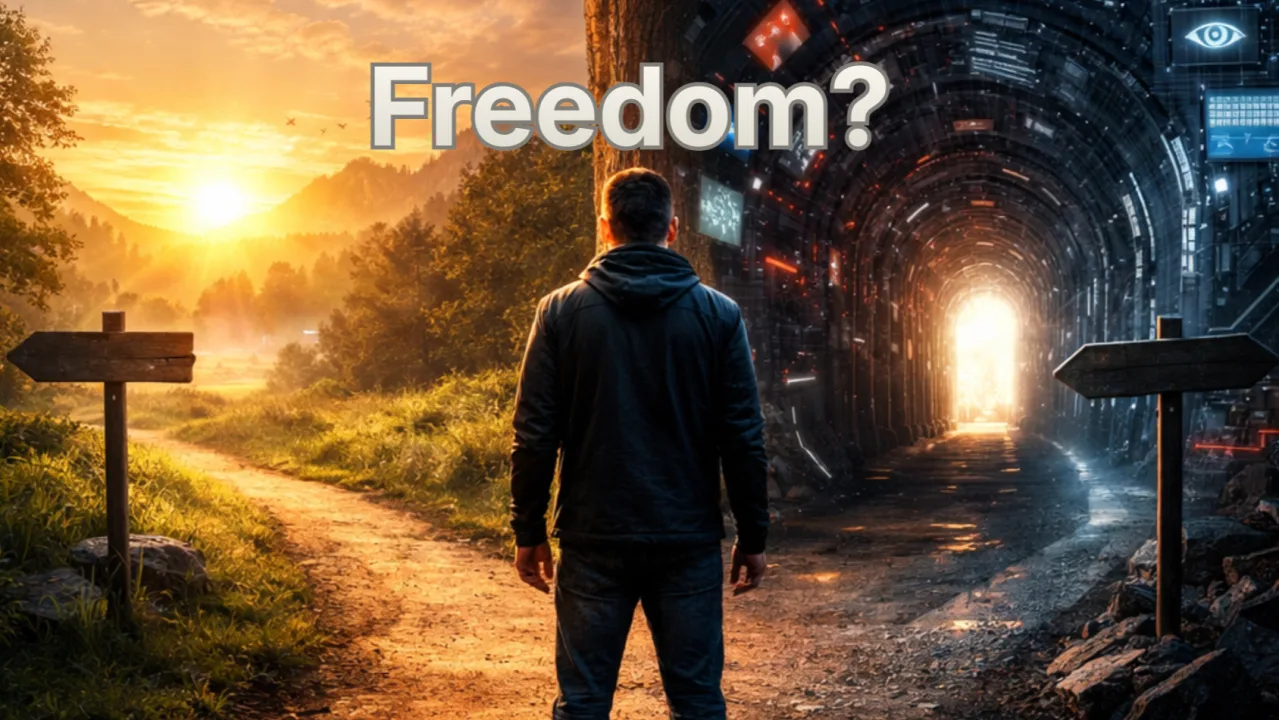
Today, a significant part of what shapes our day is decided before we consciously engage with it. Not imposed. Not forced. Simply pre-arranged. We didn’t lose agency — we stopped needing to use it. That distinction matters more than it seems.
Large behavioral shifts rarely arrive as disruptions. They arrive as conveniences. As defaults, shortcuts, optimizations. They reduce friction, save time, lower effort. Over time, they quietly redefine what is expected of a human, not by limiting freedom, but by making effort optional. And what becomes optional tends to fade.
Most of us still make major decisions. Those remain visible and reassuring. The shift happens elsewhere, in the small, continuous choices that once required attention: what to read, what to prioritize, which route to take, who to respond to first. Increasingly, these are not decisions we make. They are suggestions we accept.
A feed assembles itself. A playlist continues automatically. A calendar fills with implied priorities. Nothing here is wrong, until the question quietly disappears: is this what we would choose if nothing were suggested?
Modern life runs on defaults. Subscriptions renew automatically. Settings arrive pre-selected. Interfaces guide behavior softly but persistently. Most of us never change them, not because we agree, but because changing them costs attention. This is not a failure of intelligence; it is a rational response to cognitive overload. When environments become complex enough, we stop optimizing. We conserve energy. Over time, conservation replaces intention.
Psychologists call this automation bias. When a system offers a recommendation, we tend to follow it even when we know it can be wrong. Not because systems are always smarter, but because questioning them requires effort. The more reliable the shortcut feels, the less often judgment is exercised. Gradually, decision-making migrates outward.
Choice was once synonymous with freedom. More options meant more control. What we underestimated was saturation. When options exceed our capacity to evaluate them, choice stops empowering and starts exhausting. And when we are tired of choosing, we do not resist — we defer. This is not passivity. It is adaptation.
Uncertainty once trained us. Waiting, silence, misunderstanding, ambiguity — uncomfortable, but formative. Today, unpredictability is treated as a design flaw. Systems respond instantly. Algorithms anticipate needs. AI never ignores us. This creates predictable attention, and predictable attention often feels safer than human attention. Safety increases. Resilience quietly declines.
Technology does not only save time; it saves effort. Mental effort. Emotional effort. Social effort. Navigation tools replace orientation. AI tools replace formulation of thought. Recommendation systems replace exploration. Each removed effort spares a human capacity. And capacities that are not used do not disappear, they go dormant.
What makes this shift subtle — and therefore powerful — is that identity rarely changes through big decisions. It changes through repetition. When thousands of micro-decisions are quietly automated, what to read, where to go, how to respond, what to prioritize, we don’t lose agency all at once. We lose practice. Over time, the question is no longer “What do we choose?” but “What does the system choose for us?” Identity slowly migrates from an internal process to an external configuration.
We often talk about “soft skills” as abstract traits — adaptability, critical thinking, emotional intelligence. In reality, these are trained capacities. The mind is no different from the body. When we stop exercising it, it does not break, it weakens. We all understand what happens to the body without movement. Muscles lose tone. Endurance drops. Flexibility disappears. The same happens to the mind. Choosing the easiest cognitive path repeatedly is not efficiency; it is de-training.
We do not forget how to think. We forget because sustained thinking is no longer required. We do not lose social skills overnight. We lose tolerance for disagreement, silence, and emotional ambiguity because interactions no longer demand them. We still choose, but we stop noticing when choices are no longer ours.
Earlier systems demanded participation. We had to plan, calculate, remember, interpret. Modern systems demand consent. Scroll. Accept. Continue. Efficient. Seamless. Transformative. When participation fades, identity shifts — from actor to observer, from agent to user, from chooser to consumer. Not because we are weaker, but because the environment no longer requires strength.
Modern systems feel empowering. Everything is personalized. Everything adapts. Everything responds instantly. But personalization is not agency. Being catered to is not deciding. Control without friction becomes an illusion — smooth, pleasant, and hollow.
Here is the rarely asked question: what happens when the systems we rely on fail? Not hypothetically, but practically.
When navigation collapses, orientation skills do not instantly return. When recommendation systems disappear, many people experience paralysis rather than freedom. When automated decision layers fail, the untrained mind does not step up — it hesitates.
Dependence reveals itself only when support disappears. And a society that has outsourced judgment struggles to re-internalize it under stress.
History offers an uncomfortable parallel. Whenever decision-making is systematically removed — whether by states, ideologies, or rigid systems — the outcome follows a familiar arc. At first: convenience and order. Then: loss of agency. Eventually: frustration, anger, aggression. Revolutions do not begin with tyranny. They begin with prolonged absence of choice.
Algorithms are not governments. But the psychological pattern is the same. When people are no longer practiced in choosing, any sudden restriction — digital or political — is experienced not as limitation, but as existential threat.
This is why freedom is not a philosophical abstraction. It is a trained capacity. And capacities that are not trained do not protect us when systems fail.
This is not an argument against technology, nor a call to return to analog life. These systems exist because they solve real problems. The question is not usefulness. The question is what happens when human effort becomes optional everywhere.
Every shortcut trades effort for convenience. But effort is not merely a cost. It is training. Thinking requires effort. Choosing requires effort. Relating requires effort. Remove effort consistently, and freedom does not expand. It atrophies.
The central risk of transhumanism is not becoming machines. It is becoming unpracticed humans. Humans who can think but rarely do deeply. Humans who can choose but prefer not to. Humans who can connect but avoid friction. This is not dehumanization. It is underuse.
Most of these changes are not happening to us. They are happening for us. That is why they pass unnoticed. The threat is not coercion. It is convenience without reflection.
This article is not a prescription. It is an invitation to notice. To notice when something is decided before we arrive. To notice when acceptance replaces choice. To notice when effort disappears, and with it, a piece of freedom.
Human agency is rarely taken. It erodes when it is no longer required. And what is not required is rarely maintained.
The future will not ask whether technology advanced too far. It will ask whether humans remained practiced enough to stay human.
That question is still open. And noticing it may be the most human act left.