Source record
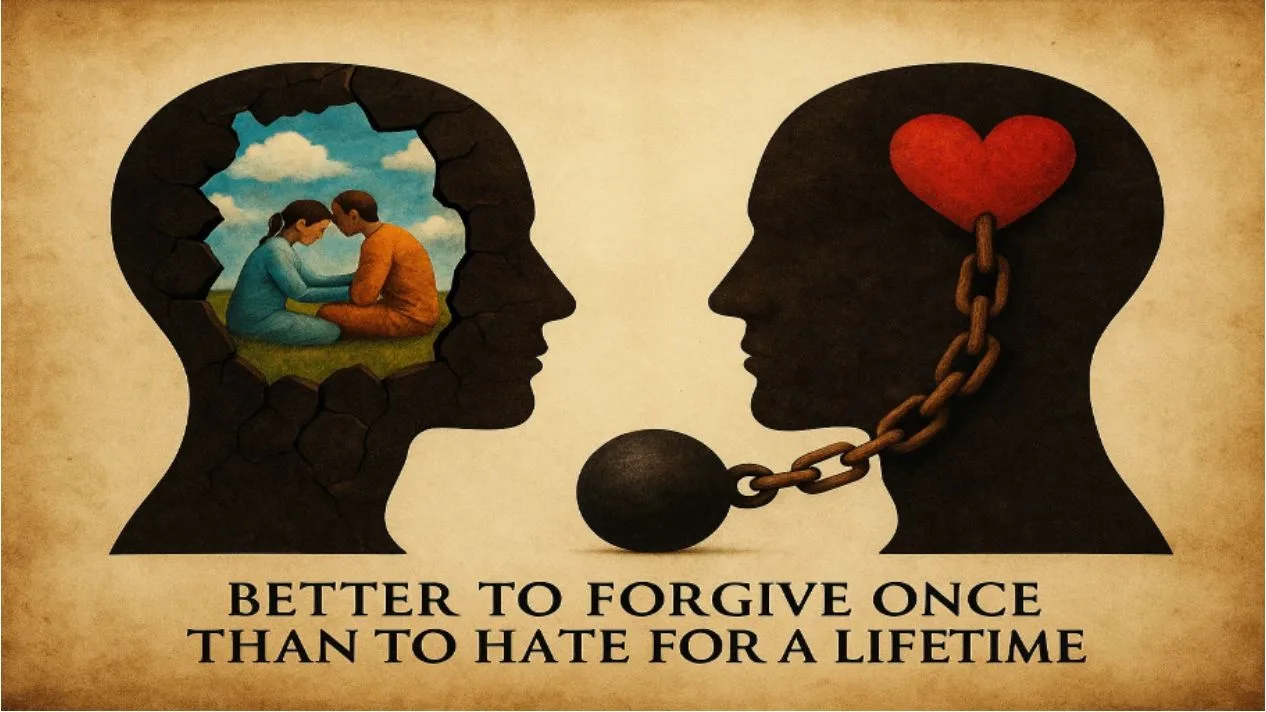
BETTER TO FORGIVE ONCE THAN TO HATE FOR A LIFETIME

Have you ever been betrayed by someone you trusted? Maybe a colleague took credit for your work, or a close friend spread your secret. What did you do? If you’re like most people, you felt the sting of anger – perhaps even swore you’d never forgive. Who hasn’t been hurt by the actions or words of another? It could be a parent who constantly criticized you growing up, a coworker who sabotaged your project, or a partner who cheated. These wounds leave resentment, bitterness, and anger – sometimes even hatred. We replay the offense in our minds, holding onto that grudge like a shield against future pain. But ask yourself: Is clinging to that bitterness helping you – or hurting you?
In today’s fast-paced, high-stress world, carrying grudges is like lugging around weights during a marathon. Life moves fast and demands our best, yet emotional baggage can hold back our growth. Forgiveness, on the other hand, can be a game-changer. Psychologists and leadership experts note that forgiveness isn’t just a moral virtue – it has real, tangible benefits. In high-pressure environments, choosing to forgive has been linked to clearer thinking and reduced stress. In fact, research shows that holding onto anger keeps our brain’s threat response in overdrive, spiking stress hormones like cortisol, whereas practicing forgiveness can help shift our brains into a calmer, more rational mode.
Why is this so crucial now? Because our modern lives demand constant adaptation and resilience. Transhumanist ideal soften talk about upgrading human capabilities – but perhaps the most profound “upgrade” is internal. Think of forgiveness as an emotional self-evolution, a conscious decision to become a higher version of yourself. By letting go of grudges, you free up mental and emotional energy to focus on growth, creativity, and connection. In essence, forgiving is like installing a mental upgrade that allows you to move through life lighter and more focused on the future rather than trapped in the past.
If forgiveness is so freeing, why do we cling to resentment? Psychologically, holding a grudge can feel safer than forgiving. Our brains evolved to protect us from being hurt or exploited again. As evolutionary psychologists explain, forgiveness is emotionally difficult because we’re wired to avoid being taken advantage of – the instinct to “hit back or avoid the exploiter” is deeply rooted in us. In other words, nursing a grudge is our mind’s way of saying, “I won’t let that happen to me again.” For example, if a colleague publicly humiliated you at work, your anger might feel like a shield of justice. If a friend betrayed you, stewing in resentment might seem like proof that you won’t be fooled twice.
The trouble is, dwelling on hurtful events only hurts us more in the long run. When you repeatedly replay the wrongdoing, grudges filled with resentment and hostility can take root. Negative feelings start to crowd out positive ones, until you’re swallowed up by bitterness or a sense of injustice. Think about it: have you ever been so wrapped up in anger about the past that you couldn’t enjoy the present moment? That’s the emotional stagnation a grudge creates – you get stuck in the same loop of pain, unable to move forward. In contrast, letting go (even a little) can release that stagnation. It’s been said that holding onto anger is like drinking poison and expecting the other person to die. Your grudge punishes you, not just the person who hurt you. Recognizing this is the first step towards freeing yourself.
So why forgive? Because the benefits are remarkable – and proven. Let’s start with the personal: Forgiveness brings peace of mind and tangible health rewards. Medical experts note that letting go of grudges can lead to healthier relationships, improved mental health, less anxiety and stress, lower blood pressure, a stronger immune system, better heart health, and higher self-esteem. In short, releasing resentment can literally improve your body’s well-being, from your cardiovascular health to your psychological balance. Chronic anger, on the other hand, keeps your body in fight-or-flight mode – adrenaline pumping, blood pressure up, immune system weakened. It’s no surprise that studies have found unforgiveness fuels cortisol spikes and burnout. Forgiveness, by calming that stress response, is associated with lower stress levels and fewer symptoms of depression.
The benefits extend beyond health. Forgiveness can actually boost your career and performance at work. Research in professional settings shows that forgiving colleagues or bosses is linked to higher productivity, less absenteeism, and fewer sick days. Employees who practice forgiveness tend to experience less interpersonal stress and burnout, which translates into more focus and creativity on the job. Think about it: an employee consumed by a grudge is often disengaged, less collaborative, maybe even looking for revenge. In contrast, those who let go and move on foster better teamwork and a more positive work culture. One study found that holding onto workplace anger led to disengagement and even aggressive behavior, whereas a forgiving disposition reduced stress and improved overall well-being at work. Leaders have discovered that a culture of forgiveness fuels trust, innovation, and stronger team cohesion – because people aren’t walking on eggshells or stuck in past conflicts. In your own career, forgiving a mistake (whether by you or others) can clear mental roadblocks, improve your reputation as a team player, and allow you to tackle new challenges unencumbered by old baggage.
And of course, personal relationships deepen when forgiveness is in the picture. Friends, partners, and family members feel safer and closer when they know mistakes can be forgiven. Grudges erect walls; forgiveness builds bridges. By choosing empathy over hostility, you open the door to honest dialogue and healing. Over time, this leads to stronger bonds and a more positive, hopeful outlook on life. Studies even suggest that people who forgive readily tend to be more optimistic and satisfied with their lives. The act of forgiving releases not only tension but also fuels positive emotions – compassion, understanding, and even love – all of which enrich your connections with others.
Great, forgiveness is powerful – but how do you actually do it, especially when it’s hard? Forgiveness is not a one-time switch you flip; it’s a skill you can strengthen with practice. Here are some practical steps and exercises to help you forgive and let go, even in small ways:
Reframe the Story: Start by changing how you interpret the offense. Instead of seeing it as a personal attack that must be avenged, try to view it from a broader perspective. Practice a bit of empathy (yes, even for the person who hurt you). Ask yourself: What might have led them to do this? This isn’t about excusing bad behavior, but about understanding that the offender is human and imperfect too. Sometimes, considering the other person’s perspective can reduce the anger’s intensity. For instance, maybe that rude coworker was under immense pressure, or that friend who snapped at you was going through their own pain. When you reframe the narrative, you transform from a passive victim into an active survivor who is learning from the experience.
Practice Small Letting-Go Exercises: You don’t have to start with your deepest wounds. Build your “forgiveness muscle” by letting go of minor annoyances first. Did someone cut you off in traffic this morning? Instead of cursing, take a deep breath and let it go. Did your spouse forget to take out the trash again? Rather than stewing, gently forgive the oversight. These small acts are like emotional push-ups – they strengthen your ability to release anger in bigger situations. Another simple exercise is keeping a forgiveness journal: jot down daily one thing that upset you and consciously say, “I release this.” It could be as tiny as a stranger’s snub. Over time, you’ll notice these things bother you less and less. Each day, choose one small grudge to drop – it’s a training regimen for your heart.
Write an Unsent Letter: One powerful technique therapists recommend is the unsent letter. Write a letter to the person who hurt you, but don’t send it. Pour out all your emotions on paper – describe what happened, how it made you feel, and what you wish had been different. Be brutally honest; this letter is for your eyes only. Then, in the letter, explicitly state your forgiveness. For example, “I choose to forgive you for doing X. I am letting go of this anger.” You might even express understanding or empathy if you can manage it. This exercise helps externalize your pain and resentment in a safe way. As one psychologist noted, an unsent letter allows you to express and release anger, frustration, and grief in a productive, beneficial manner. Many people feel a weight lifted after writing such a letter – you might even ritualize it by tearing it up or burning it (safely) as a symbolic release.
Try a Forgiveness or Acceptance Meditation: Our minds often hold onto hurt because we haven’t given ourselves the space to process and release it. Meditation can be a powerful tool for cultivating forgiveness. One approach is a short loving-kindness meditation focused on both yourself and the other person. Find a quiet spot and spend 5-10 minutes breathing deeply. As you breathe, bring to mind the person (or yourself, if it’s self-forgiveness) and silently repeat phrases of goodwill. For example: “May I be free from anger. May [Name] be free from anger. May we both be peaceful.” It’s normal if feelings of resistance come up – just notice them and return to the intention of goodwill. The goal isn’t to condone what happened, but to unhook your heart from the bitterness. By extending even a tiny bit of compassion, you loosen resentment’s grip. Remember to include yourself in this compassion. Treat yourself with the same kindness and understanding you’d offer a good friendwho was hurt. Even a brief guided meditation or a few moments of mindful breathing and saying “I release this” on each exhale can foster acceptance. Over time, these moments of mindfulness help heal emotional wounds and make forgiveness feel more natural.
Rinse and Repeat (Forgive Again, as Needed): Finally, realize that forgiveness is rarely a one-and-done event. You might forgive someone today, and then next week some memory flares up your anger again. That’s okay. Forgiveness is a process – you might have to revisit it multiple times for the same issue. Think of it like peeling layers of an onion; each time you forgive, you peel away one layer of hurt. Keep practicing the above steps. Each round, you’ll likely find the hurt has a little less hold over you than before. Persistence is key to truly letting go.
Let’s tackle a common myth: Forgiving means you’re weak or that you’re condoning what happened. Nothing could be further from the truth. Forgiveness is not about excusing the bad behavior or pretending it never happened. The Mayo Clinic explicitly states that forgiving someone doesn’t mean forgetting the harm done or absolving the person of responsibility. You can forgive and still maintain boundaries. You can forgive and choose not to reconcile if the situation is unhealthy. In fact, forgiveness can go hand-in-hand with holding someone accountable – the difference is, you’re holding them accountable without the poison of hatred in your heart. As one leadership coach put it, forgiveness doesn’t mean excusing poor behavior; it means handling it in a way that fosters growth, not lingering resentment.
Far from being a sign of weakness, the ability to forgive is often a mark of great strength and emotional intelligence. It takes courage to let go of a grievance and trust yourself to move forward. Think of it this way: anyone can hold a grudge – that’s the easy path of least resistance. But to forgive, especially when you’ve been deeply hurt, is to rise above your base instincts. It’s choosing growth over vengeance, peace over perpetual war. In the professional world, forgiveness is increasingly seen as a strength: wise leaders embrace forgiveness as a strategy for success, not a soft concession. And in your personal life, choosing to forgive means you refuse to let your pain define you. It’s you saying, “I’m in control of my story, not the person who hurt me.” There’s nothing weak about that – it’s empowerment at its finest. Remember, forgiving is not about setting the offender free; it’s about setting yourself free.
Sometimes, the best way to understand the power of forgiveness is through a story. Consider the story of Maya (a composite of many true stories). Maya had been harboring a bitter grudge against her former business partner for years after a painful split. She felt betrayed and cheated, and the anger weighed on her. Every time someone mentioned her ex-partner’s name, Maya’s stomach tightened and her day was ruined. It went on like this for a long time – she was stuck, emotionally and even professionally, as she turned down new collaborations out of fear of being hurt again.
One day, on the advice of a friend, Maya decided to try something radical: she attempted to forgive. She sat down and wrote an unsent letter to her old partner, pouring out all her resentment and hurt. Then she wrote, “I forgive you. I’m letting this go so I can move on.” She later described what happened as if a weight had literally been lifted off her shoulders. “I felt a lightening inside, like letting go of heavy weights,” she said, marveling at the sense of relief. It wasn’t that all her pain vanished instantly – but it shrank to a manageable size. In the following weeks, Maya noticed changes. She no longer grimaced at the mention of her ex-partner; instead, she felt a neutral acceptance. Her energy and focus returned to her own life and business. In fact, freed from the burden of that grudge, she found herself more creative and open to new partnerships. Her friends remarked that she seemed “lighter” and happier. By forgiving once, she had freed herself from hating forever, and it transformed her outlook. Maya’s story echoes countless others: forgiveness can be the turning point that takes you from victim to victor in your own life.
Life is too short – and the world too fast-moving – to bear the heavy chains of hatred and resentment forever. Every time you forgive, you’re not just being kind; you’re upgrading yourself. You’re choosing to evolve into a more conscious, unhindered version of you. It’s like shedding an old skin that no longer serves you. Better to forgive once than hate forever – because that single act of grace can spark a domino effect of personal growth, better health, and stronger relationships.
So here’s my challenge to you: forgive one small thing today. It could be something as simple as forgiving the driver who cut you off, or forgiving yourself for an error you made at work. Notice how it feels to consciously release that grudge – even if it’s tiny. That feeling of lightness? That’s you, leveling up emotionally. Over time, these small acts of forgiveness pave the way for tackling the bigger grudges. And as you do, remember that you are not absolving the wrongdoer of consequences; you are absolving yourself of the continued suffering. You’re choosing peace over pain, growth over grudge.
Imagine the higher version of yourself – the one unburdened by past hurts, calmly focused on new horizons. That version of you is within reach, and forgiveness is one key to unlocking it. In a world where we strive to be better, smarter, more everything, don’t overlook the power of a healed heart as the ultimate personal upgrade.
I’ll leave you with a question to ponder (and I invite your thoughts): What is one grudge – big or small – that you can choose to let go of today, to become a freer, more evolved you?