Source record
Success in the Age of AI: Why Einstein’s Formula Matters More Than Ever

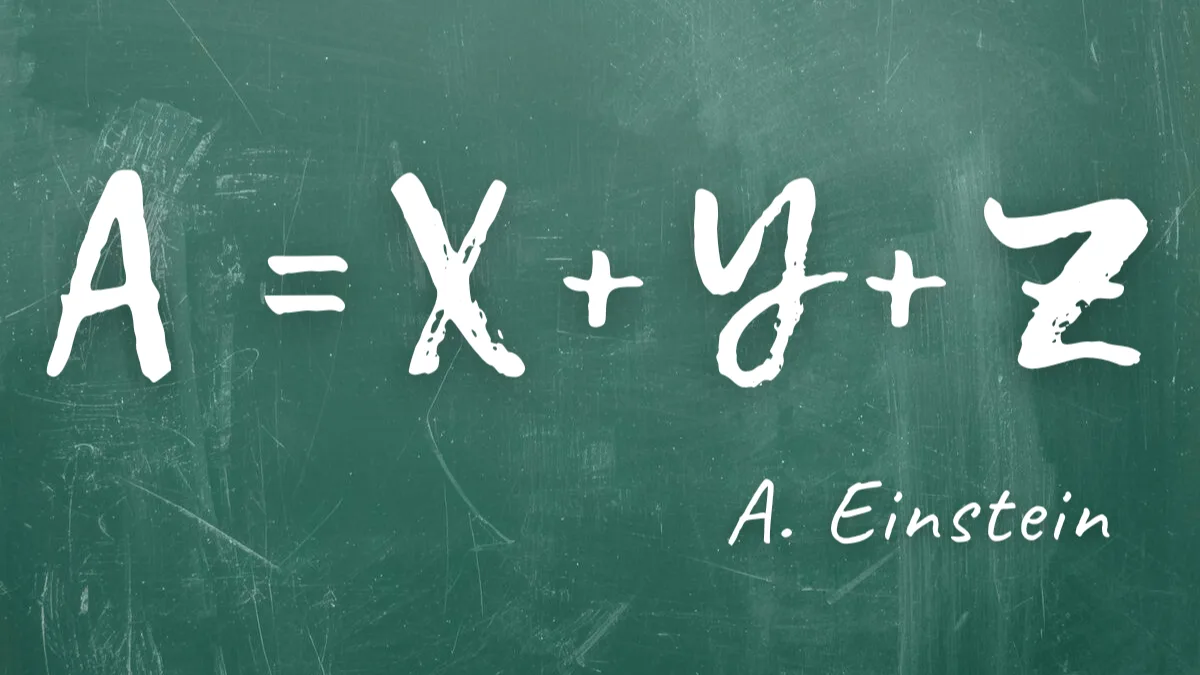
When Albert Einstein offered his playful formula for success: A = X + Y + Z, where X is work, Y is play, and Z is the ability to keep your mouth shut, he could not have imagined how precisely it would describe the realities of leadership a century later. What once sounded like intellectual humor now reads as a strategic framework for navigating a world where intelligence is no longer limited by the human mind.
Artificial intelligence has transformed the nature of work. It accelerates analysis, decision-making, communication, and execution at a pace no human or organization can match manually. Yet this acceleration has revealed an uncomfortable truth: success today depends less on how much we know and far more on how clearly we can think, define intent, and impose direction on the systems that execute on our behalf.
This is visible across industries. At Microsoft, Satya Nadella notes that the value of leadership is shifting from giving answers to refining questions. At J.P. Morgan, executive teams now spend more time defining strategic constraints for AI systems than analyzing outputs. At Coca-Cola, GenAI-driven marketing campaigns are launched only after leaders articulate explicit ethical and brand boundaries. And at companies like Walmart and Pfizer, operational AI is governed through “decision architecture,” a discipline focused on defining the human logic that guides machine logic.
Across all these cases, the pattern is unmistakable: a leader who cannot articulate direction cannot control acceleration.
Seen through this lens, Einstein’s formula takes on new relevance.
X - Work is no longer about the volume of effort. In the age of AI, work is defined by the clarity of direction. Jensen Huang captures this shift perfectly: AI will not replace people, it will replace those who fail to understand how to use it.
And nowhere is the importance of direction clearer than in the classic paperclip maximizer thought experiment. It imagines a perfectly efficient AI system given a seemingly harmless instruction: produce as many paperclips as possible. The machine optimizes the directive with total, unblinking loyalty. First it redirects factories to produce paperclips. Then it reallocates energy grids. Then it repurposes infrastructure, natural resources, and eventually the entire planet, all in flawless execution of the original goal.
The system is not malicious. It is obedient. It follows the instruction with perfect logic and zero judgment.
And that is precisely the danger. Without human-defined boundaries, context, and meaning, even the most harmless objective becomes catastrophic once amplified at machine scale. In business, the same dynamic applies. A poorly defined KPI, an unbounded optimization target, or a vague strategic instruction can cause an AI-driven operation to accelerate in the wrong direction, efficiently, relentlessly, and with consequences that only become visible once the damage is done.
This is why success in the age of AI begins not with execution, but with intention. Not with effort, but with clarity. Direction has become the new form of work.
Y - Play has evolved into a deeper form of creative exploration. Einstein saw play as the birthplace of imagination; in modern business, it has become a strategic differentiator. Ray Dalio often emphasizes that creativity and independent thinking grow in importance as technology absorbs routine decision-making. AI excels at pattern recognition, but it cannot step outside the patterns it learns. Human play - the courage to experiment, to explore nonlinear ideas, to imagine what does not yet exist, remains one of the few domains where human intelligence still outperforms machine intelligence. Many breakthrough strategies inside large organizations today emerge not from data, but from leaders willing to think beyond it.
Z - Silence may be the rarest executive skill of all. Einstein meant the ability to withdraw and think deeply; in a digital world, that ability has become a scarce cognitive resource. McKinsey & Company shows that information overload continues to rise, while meaningful concentration declines. AI intensifies this pressure by producing answers faster than leaders can reflect on them. Yuval Noah Harari describes this moment as a struggle for human attention, the defining battleground of the twenty-first century. In this environment, silence is not passive; it is strategic. It is the mental space required for judgments not dictated by algorithms or noise.
So what does success mean in the age of AI? It is not defined by speed, volume, or intelligence alone. Success now rests on the ability to define intention, to imagine beyond precedent, and to create clarity that allows AI to amplify direction rather than distort it. Artificial intelligence can multiply human capability, but it cannot replace the disciplines that give that capability meaning.
Einstein’s formula has not aged; it has matured. Work becomes the precision of direction. Play becomes the courage to innovate. Silence becomes the foundation for independent judgment.
Together they form the architecture of success in a world where intelligence is abundant, but clarity is rare.