Source record
The Hidden Cost of Staying Who You Used to Be
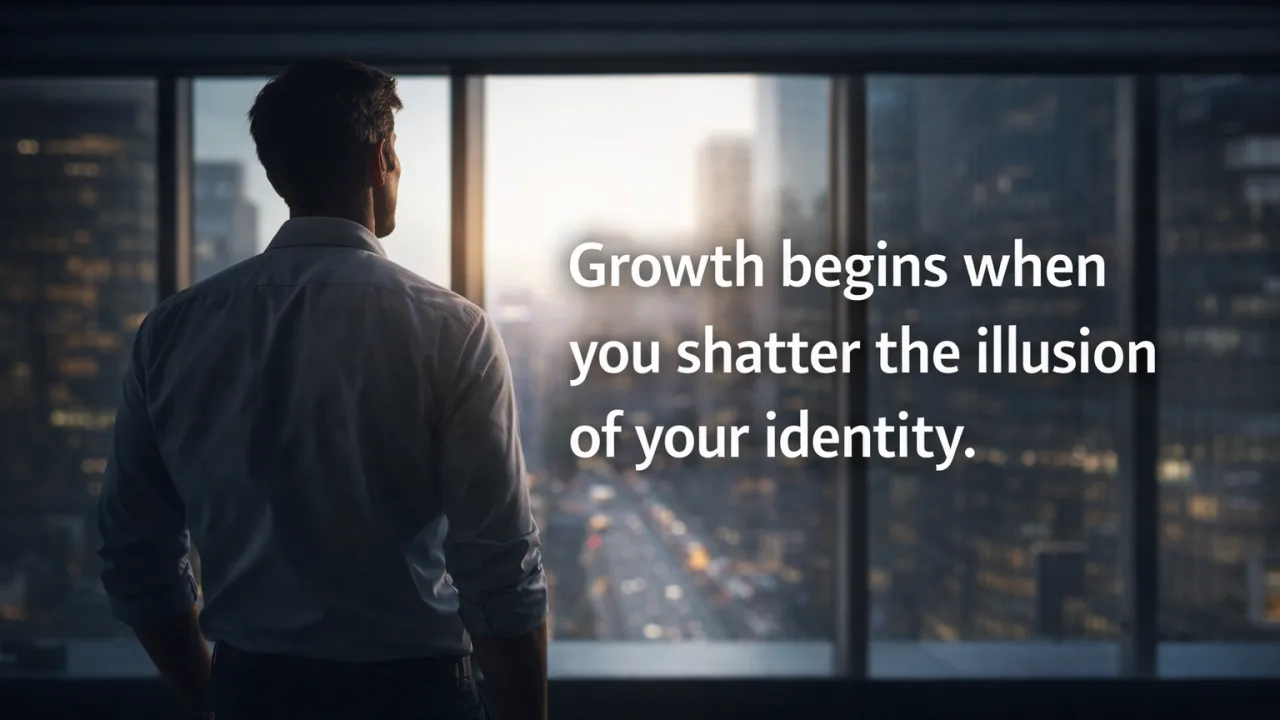
A human doesn’t fear decisions. He fears losing who he used to be.
In business, this looks different.
We say we need more data. We say the timing isn’t right. We say it requires another discussion. But most of the time, the issue isn’t analysis.
The issue is that every serious decision dismantles the previous structure of who we are.
Letting someone go means no longer being “the most loyal leader.” Changing strategy means admitting the previous hypothesis no longer works. Leaving a stable position means giving up the status we’ve grown used to. Launching a project means stepping out of the observer role and accepting risk.
A decision is not just a choice of action. It is the abandonment of an old version of ourselves.
That is what creates internal resistance.
We are not protecting the business. We are protecting our image.
On a rational level, things are often clear. The market shifts — the strategy must adapt. A team member underperforms, action is required. The company hits a ceiling, transformation becomes necessary.
Yet internally, there is a pause.
Because alongside the strategy, we must change ourselves.
When someone strongly identifies with a role, a status, or a past success, any change feels like a threat to stability. If we see ourselves as consistent, always right, predictable, experts, then any decision that challenges that image creates tension.
And in that moment, we defend not the outcome, but the narrative about who we are.
The cost of inaction is not neutral.
Delayed decisions slow momentum. They blur clarity. They signal uncertainty to the team. Over time, they erode trust, internally and externally.
We can avoid making a choice. But that is still a choice. And most often, it is a choice in favor of inertia.
There is a deeper layer here.
When I identify myself with a former version - a role, a reputation, a status - any shift feels personal. Not to the business. To me.
The decision stops being a step forward. It becomes a perceived risk of losing myself.
But when I begin to see myself not as a fixed form but as a process - as development, as movement - decisions stop feeling destructive.
They become continuation.
Not because fear disappears. But because attachment weakens.
In a fast-changing world, rigid identity becomes a liability.
When we cling to who we were, we slow down the business. When we are willing to outgrow ourselves, we accelerate.
The market does not punish course correction. It punishes inertia.
A mistake followed by adaptation is movement. The absence of decision is stagnation.
The core truth remains:
A human doesn’t fear decisions. He fears parting with who he used to be.
We don’t fear choice. We fear the change in identity that comes with it.
But growth always requires leaving the previous level behind.
The real question is not, “What if this decision turns out wrong?”
The real question is: Are we willing to change ourselves in order to move forward?
Because in today’s reality, the greater risk is not making a mistake.
The greater risk is preserving stability at the cost of momentum.